Category: Uncategorized

  • Returnable Poly Mailers: When the Dual-Seal Bag Pays for Itself

    Returnable Poly Mailers: When the Dual-Seal Bag Pays for Itself

    Every online order has a shadow: the chance it comes back. For most stores that possibility is treated as a problem for the returns team, not the packaging team, which is why the mailer that carried the product out the door usually ends up in the trash the moment the box is opened. A returnable poly mailer changes that calculation. By building a second seal into the same bag, it lets the outbound package become the return package, and for the right catalog that single design choice removes real cost and real friction. The question is whether your catalog is the right one.

    How a returnable mailer is actually built

    A standard poly mailer has one adhesive strip: peel the liner, fold the flap, ship. A returnable mailer adds two features. First is a tear strip, a perforated opening line the customer pulls to get in without scissors, which keeps the rest of the bag intact. Second is a second adhesive strip positioned below the first. The brand uses the top strip to seal the outbound shipment; if the customer needs to return the item, they reload the bag, peel the second strip, and reseal it for the trip back. No tape, no hunting for a box, no new packaging. These bags are commonly produced in a familiar 2.5 mil gauge, the same everyday thickness used for standard mailers, so the durability tradeoff is minimal.

    The mechanical simplicity is the point. Nothing about a returnable mailer requires the customer to understand it in advance; the tear strip and second seal are self-explanatory in the moment, which is exactly when a frustrated returner is least patient.

    Start by reading your return rate

    Whether the second strip earns its place depends almost entirely on how often your products come back, and that varies enormously by category. Across all US ecommerce, roughly one in five online orders is returned. But the blended average hides the spread that matters. Apparel and accessories run the highest, commonly 30 to 40 percent, with footwear close behind at 25 to 35 percent, both driven by fit and the well-documented habit of ordering two sizes to keep one. At the other end, electronics sit around 8 to 10 percent and beauty and personal-care items around 4 to 10 percent, partly because many are consumable or not resalable once opened.

    Those numbers are the first filter. A fashion brand where a third of shipments reverse is operating in a completely different reality from a supplement brand where almost nothing does, and the packaging should reflect that rather than defaulting to one bag for everything.
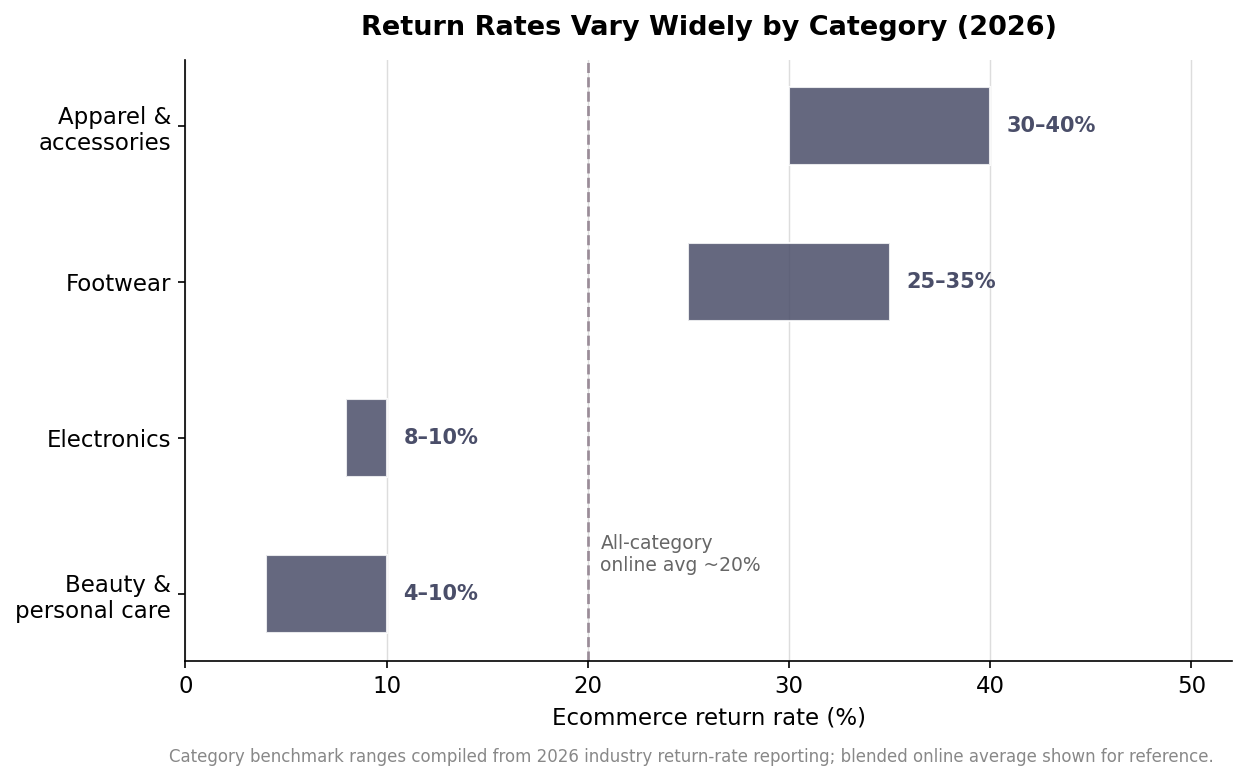
    Horizontal bar chart of 2026 ecommerce return rate ranges by category: apparel and accessories 30 to 40 percent, footwear 25 to 35 percent, electronics 8 to 10 percent, beauty 4 to 10 percent, with an all-category average near 20 percent
    Return rates by category set the baseline for whether a returnable mailer is worth its added cost.

    When the dual-seal bag pays off

    The returnable mailer earns its slightly higher unit cost when two things are true: a meaningful share of orders come back, and the returned item is something you want protected and resalable when it arrives. Apparel, footwear, and accessories check both boxes, which is why reversible packaging shows up most in fashion. For those categories, every avoided return trip is one less box the customer has to source, one less chance the garment gets stuffed into something inadequate, and one less support ticket asking how to send it back.

    Where it pays off less is the low-return, low-reverse-logistics end of the catalog. If four to ten percent of your beauty orders come back and most of those are simply refunded rather than physically returned, paying for a second adhesive strip on all one hundred percent of shipments is subsidizing a return that rarely happens. The honest math is per-catalog: multiply your real return rate by the number of shipments, weigh the extra per-unit cost of the returnable bag against what you currently spend enabling returns, from prepaid label packaging to customer-service time, and see whether the reversible design actually clears the bar. For a high-return catalog it usually does; for a consumable one it often does not.
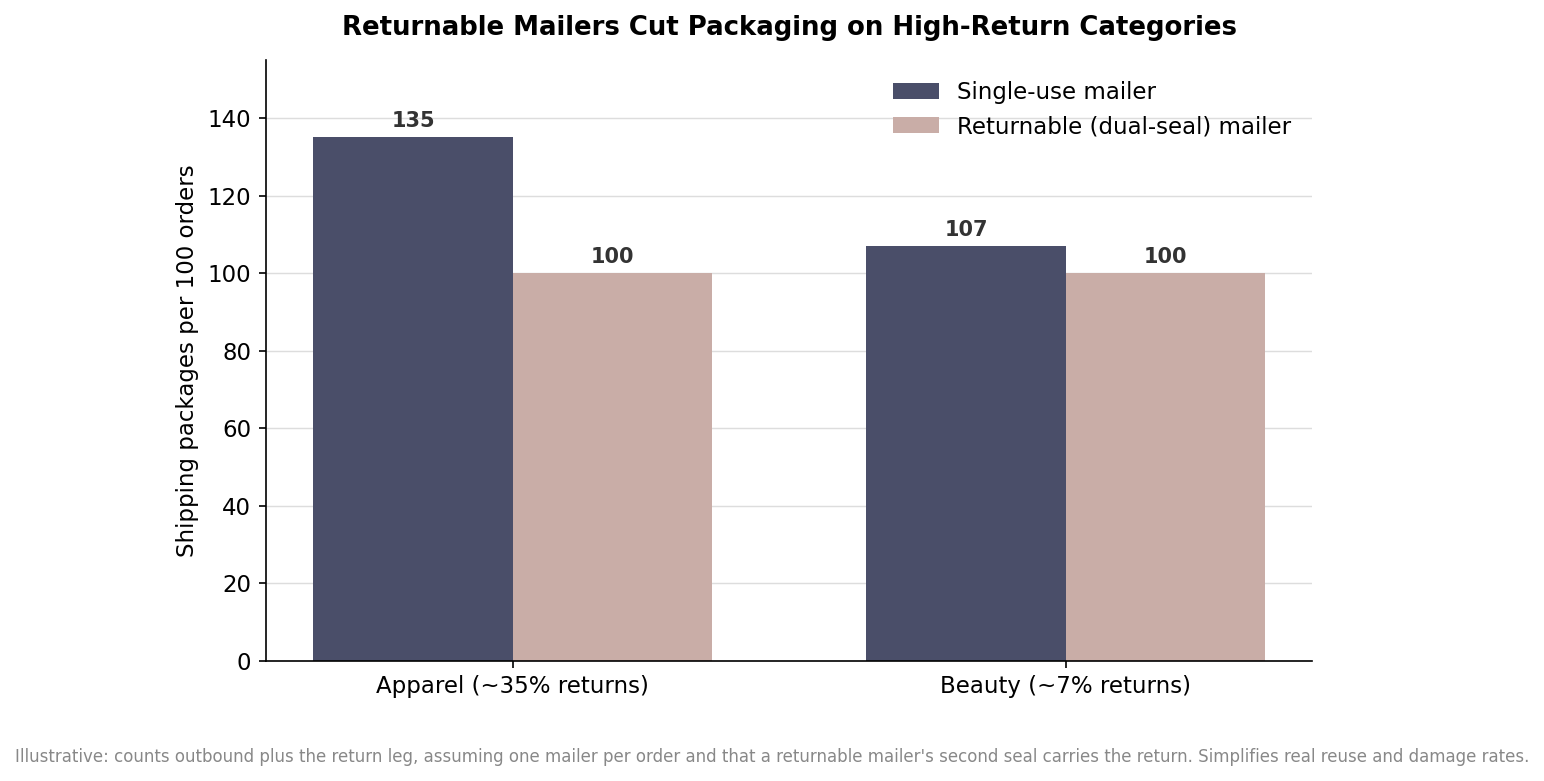
    Grouped bar chart comparing shipping packages per 100 orders for single-use versus returnable mailers: apparel 135 versus 100, beauty 107 versus 100
    An illustrative view of how reusing the outbound bag for the return leg saves the most on high-return catalogs.

    What to specify so the second life works

    A returnable mailer only helps if it is sized and printed for both journeys. Size it to the product with enough room that a customer can refold and reseal without fighting the bag; a mailer packed to the edge outbound is miserable to reload. Keep the gauge sensible, since the bag now needs to survive two trips through the mail rather than one. Confirm where the second adhesive strip sits relative to the tear line, because a poorly placed strip leaves too little material to form a clean return seal.

    Branding deserves the same double-journey thinking. The exterior print is seen twice, once by your customer and once by whoever handles the return, so the design is doing brand work on the way back as well. Many brands print short return instructions or a “peel here to return” cue directly on the bag or its interior, turning the packaging itself into the returns manual. If you run a reuse or take-back program, the mailer is also the most visible place to say so.

    The experience and sustainability angle

    Beyond cost, a returnable mailer removes the single most common complaint about online returns: the logistics of repackaging. A customer who can reseal the original bag in ten seconds is measurably more likely to complete an exchange rather than abandon it, and a smooth return is one of the strongest predictors of whether that shopper buys again. There is a sustainability story too, though it should be told carefully. A bag used for two trips instead of one halves the packaging for any order that comes back, and that is a real reduction, but it applies only to the orders that actually reverse, not the whole run. Claim the benefit you can defend, which is fewer single-use packages on the returns you do receive, and let the honest version do the work.

    Returnable mailers are not a universal upgrade. They are a targeted tool that shines on catalogs with high return rates and resalable goods, and adds cost without much payoff on catalogs without them. Know your category’s return rate, run the per-order math, and spec the second seal where it earns its keep.
  • Flexographic vs. Digital Printing for Custom Poly Mailers: How to Choose

    Flexographic vs. Digital Printing for Custom Poly Mailers: How to Choose

    The single decision that most shapes what a run of custom poly mailers costs is not the film or the size. It is the print method. Flexographic and digital printing produce a similar-looking mailer, but they price the job in completely different ways: one front-loads a fixed setup cost and then makes each mailer very cheap, the other charges almost nothing to start and a bit more per piece. Knowing which curve you are on, and where the two cross, is what keeps a brand from overpaying for its packaging.

    What flexographic printing does well

    Flexographic printing, usually shortened to flexo, is the workhorse of high-volume film printing. It works by etching your artwork onto flexible relief plates, one plate per spot color, and mounting them on a rotating cylinder that inks a continuous roll of film. Because the plates are a physical, one-time investment, flexo carries a real setup cost before the first good mailer comes off the line. Once the press is running, though, the marginal cost of each additional mailer is very low. That economics makes flexo the right tool when you are ordering in the thousands and printing a small number of solid, consistent colors, such as a wordmark and an accent shade. It reproduces flat brand colors cleanly and holds registration well across a long run.

    Where digital printing wins

    Digital printing skips the plates entirely. Artwork goes straight from a file to the press, so there is no plate fee and no meaningful setup charge. That changes the math at the low end: a run of a few hundred mailers, or a design with photographic detail and many colors, is usually cheaper and faster digitally. Digital also makes short, frequent reorders practical, which suits a brand that is still testing designs or runs seasonal variants. The trade-off is per-unit cost. Without plates to amortize, the price of each mailer stays relatively flat as volume climbs, so at large quantities digital loses the cost advantage it holds at the bottom.

    The volume where the two cross over

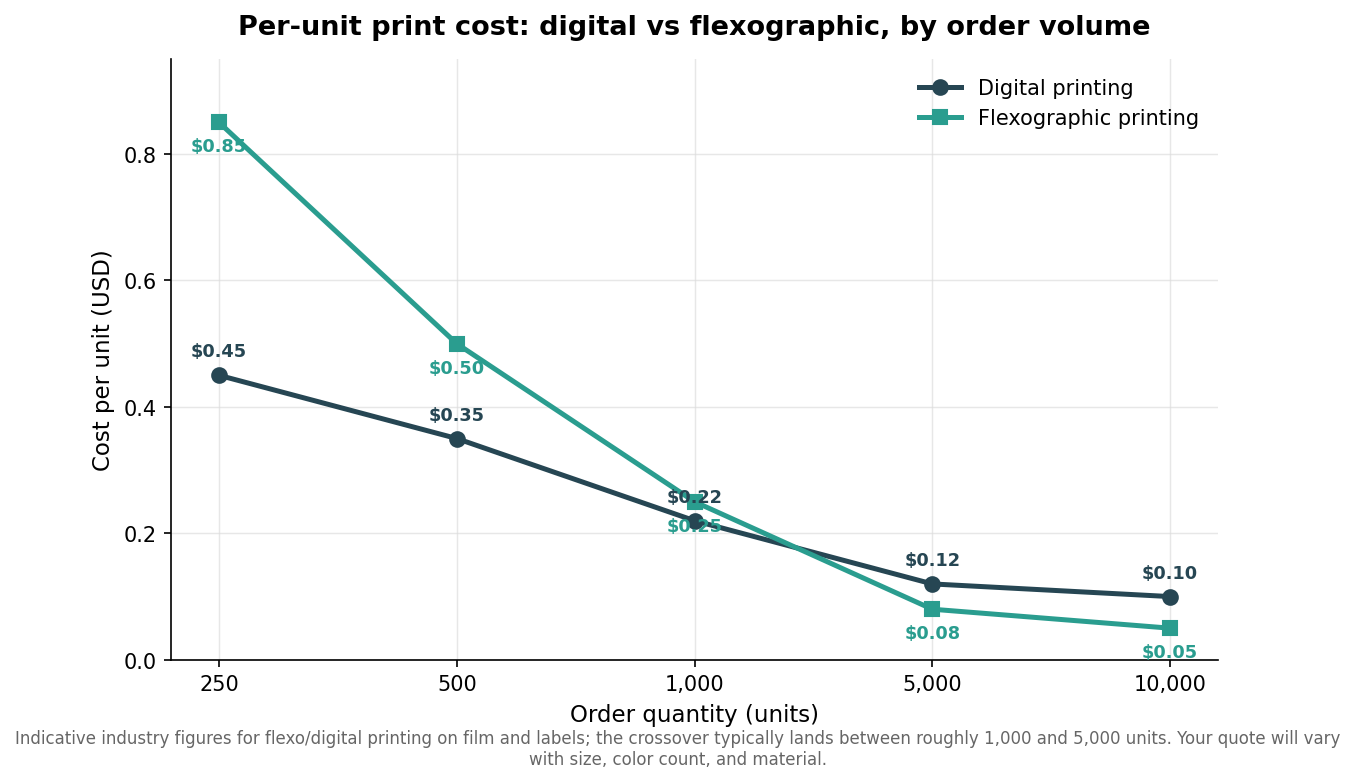
    Because flexo trades a high starting cost for a low per-piece cost and digital does the opposite, there is a crossover volume where they meet. For film and label work, that break-even typically lands somewhere between 1,000 and 5,000 units, depending on how many colors the design uses and which material you print on. Below the crossover, digital is cheaper because you avoid the plate bill. Above it, flexo pulls ahead and keeps widening its lead as volume grows.

    Line chart comparing per-unit print cost of digital and flexographic printing across order volumes from 250 to 10,000 units
    Digital is cheaper at low volumes; flexo overtakes it as quantities climb past the crossover.

    The pattern in the numbers is the point rather than any single figure. At a few hundred pieces, digital can run roughly half the per-unit cost of flexo because flexo is still paying off its plates. By 5,000 pieces the order flips, and at 10,000 and beyond flexo can cost a fraction of the digital price per mailer. If your annual volume sits near the crossover, the tie-breaker is usually reorder behavior: one large flexo run is cheapest per piece, but if you expect to change the art or split the year into several small drops, digital’s zero setup can win on total spend even at moderate volume.

    Why color count drives the setup bill

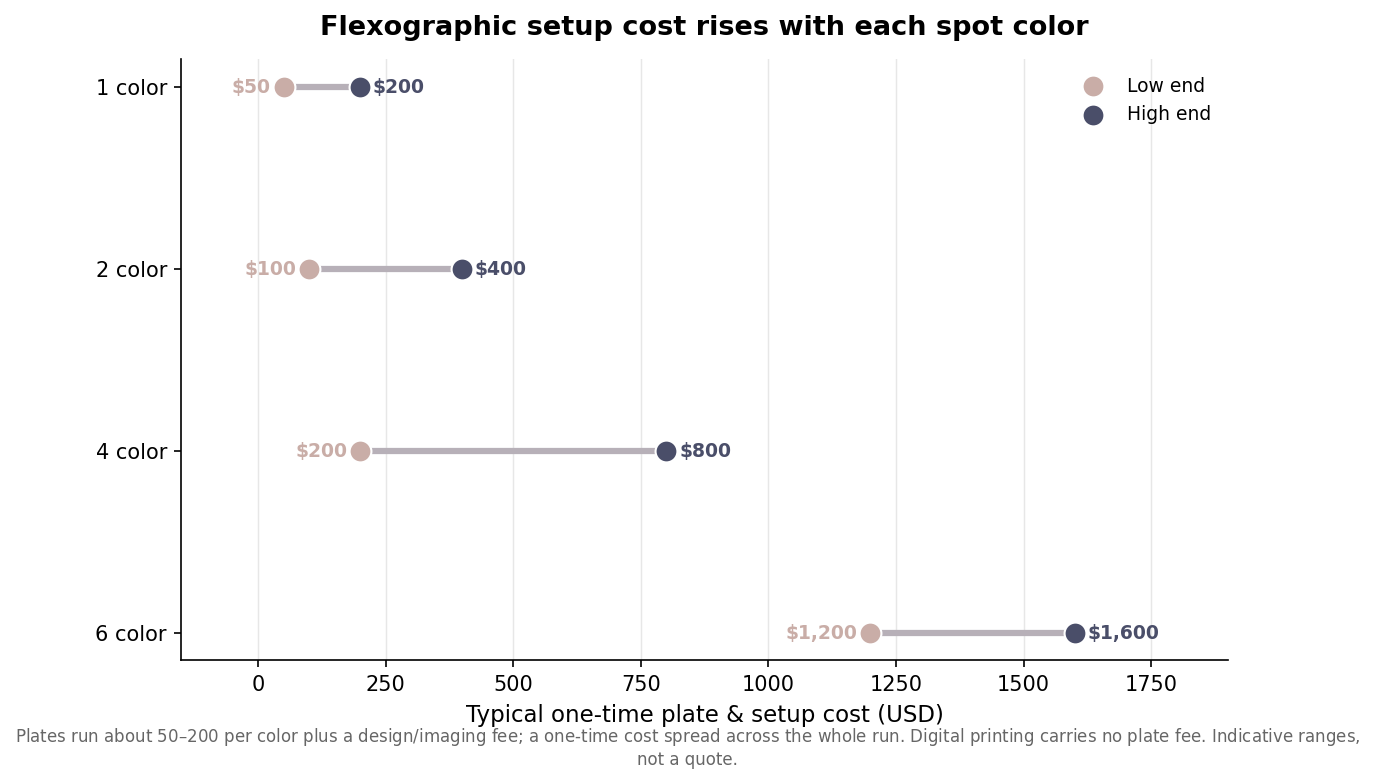
    The reason flexo setup is not a single number is that each spot color needs its own plate. Plates commonly run about $50 to $200 per color, plus a design and imaging fee, so a one-color mailer might carry a modest plate charge while a four-color job can reach several hundred dollars before anything prints. Six-color designs push the setup past a thousand dollars. None of that recurs on a reorder of the same art, since the plates already exist, but it is real money on a first run and it is the main lever you control.

    Dot range plot of flexographic plate and setup cost by number of spot colors, from one to six colors
    Each spot color adds a plate, so flexo setup climbs steeply with color count.

    The practical takeaway is to be deliberate about color count when you print flexo. A logo that uses two brand colors instead of four can cut the setup bill roughly in half without materially changing how the mailer looks on a doorstep. If a design genuinely needs full-color imagery or a gradient, that is a strong signal to print digitally, where added colors do not add setup cost at all.

    Matching the method to your order

    Put the two curves together and a simple decision rule falls out. If you are ordering a large, stable run in a few flat colors, specify flexo and accept the plate cost as a one-time investment that pays for itself over the run. If you are ordering small quantities, testing artwork, printing photographic or many-color designs, or planning frequent short reorders, specify digital and skip the setup entirely. When your volume sits in the 1,000-to-5,000 range, ask your supplier to quote both methods for your exact size, color count, and material, then compare the all-in totals rather than the per-unit prices alone, because the setup fee is what tips the balance.

    The figures here are indicative industry ranges rather than a specific quote, and real pricing shifts with mailer dimensions, film thickness, ink coverage, and current material costs. Treat them as a way to understand which side of the crossover you are on, then get a live quote for both methods before committing to a first run. Choosing the method that fits your volume, not just the one your supplier defaults to, is one of the few packaging decisions that can move your per-order cost by a meaningful margin.

  • What Size Poly Mailer Do You Need? A Product-by-Product Guide

    What Size Poly Mailer Do You Need? A Product-by-Product Guide

    Choosing a poly mailer size looks trivial until the first batch arrives and the bags are either splitting at the seams or swallowing a single folded shirt in a sea of slack film. The size you pick decides three things at once: whether the product survives the trip, what the package weighs on the carrier’s scale, and how the parcel looks when it lands on a doorstep. This guide works the way real fulfillment does, starting from the item you actually ship and working outward to the bag, with concrete dimensions you can order against.

    Start with the item, not the bag

    The most common sizing mistake is shopping for a mailer by name rather than by fit. A “10 by 13” sounds standard, but standard for what? Lay the product down the way it will ship, folded as you would fold it for packing, and measure the flat footprint plus its packed thickness. A single cotton tee folds to roughly an eight by ten inch rectangle less than an inch thick; a heavyweight hoodie folded the same way can reach eleven by fourteen inches and two inches thick. Those are the numbers that matter, not the garment’s label size. Once you have the packed dimensions, everything downstream, the bag size, the film thickness, and the postage tier, follows from them.

    A size-by-size reference

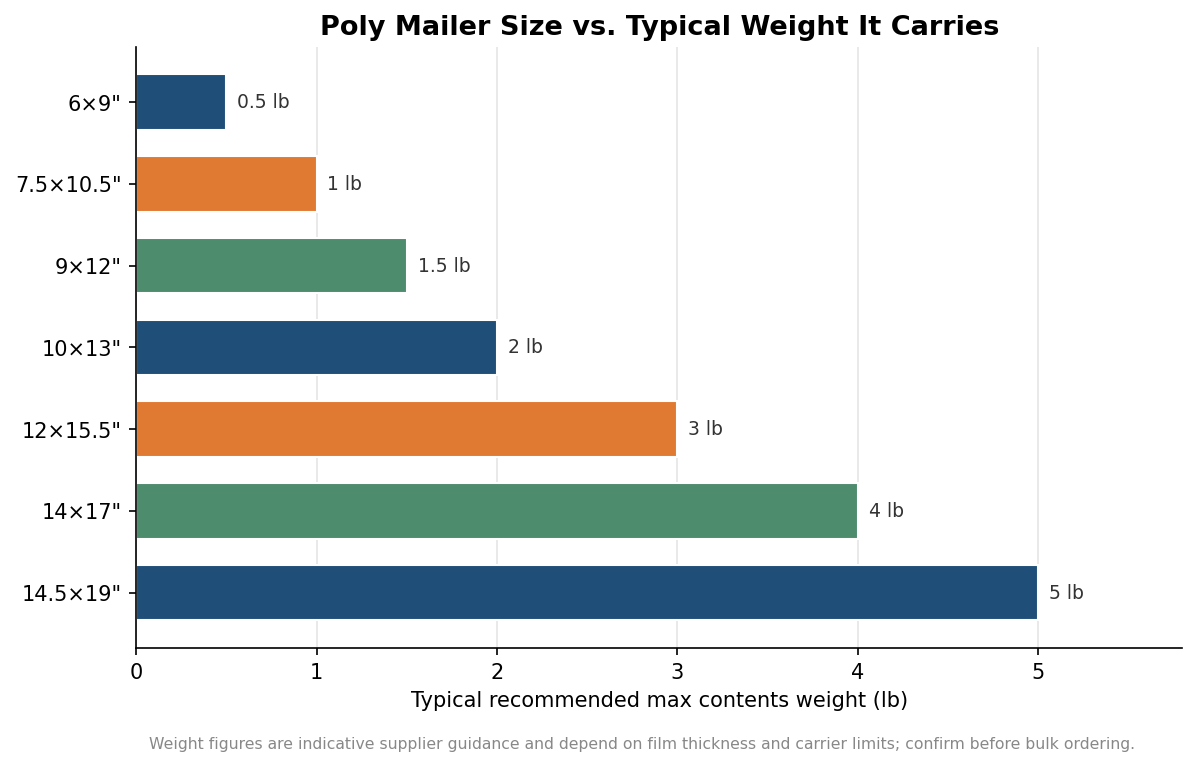
    Across most suppliers the poly mailer range runs in fairly consistent steps, and each step has a natural home. The 6 by 9 inch bag is the accessory size: jewelry, phone cases, cables, cosmetics, and other items under roughly half a pound. The 7.5 by 10.5 inch handles a single small garment such as a folded tee, a scarf, or a few pairs of socks, up to about a pound. The 9 by 12 inch is the everyday apparel bag for one shirt, a blouse, or a pair of shorts, comfortable to about a pound and a half.

    The 10 by 13 inch is the workhorse of e-commerce apparel and the size most brands standardize on first; it takes an adult tee, a pair of jeans, or a light bundle up to around two pounds. Step up to 12 by 15.5 inch for sweaters, dresses, and most hoodies, roughly a three pound ceiling. The 14 by 17 inch covers bulkier single items and small multipacks near four pounds, and the 14.5 by 19 inch is the big bag for XL and XXL hoodies, coats, bedding, or several garments in one parcel, up to about five pounds. Treat those weight figures as indicative supplier guidance rather than hard limits; the real ceiling comes from the film thickness and the carrier, not the bag’s outline.

    Horizontal bar chart of poly mailer sizes from 6x9 to 14.5x19 and the typical weight each carries
    Each standard size step maps to a typical contents-weight band; treat the figures as guidance, not guarantees.

    The one formula that prevents most sizing mistakes

    If you remember nothing else, remember the headroom formula. Take the packed product’s width and add its thickness plus one inch; take the packed length and add the thickness plus two inches. Match the result up to the nearest size that clears both numbers. The extra inch on the width lets the film wrap the depth of the item without straining the side seals, and the extra two inches on the length leave room for the fold-over lip and the adhesive strip. A folded tee measuring eight by ten by one inch, run through the formula, lands at roughly ten by thirteen, which is exactly why that size is so popular for shirts. Skip the headroom and the seal takes the stress; every returned “arrived split” parcel traces back to a bag chosen a size too tight.

    Bigger is not the safe default

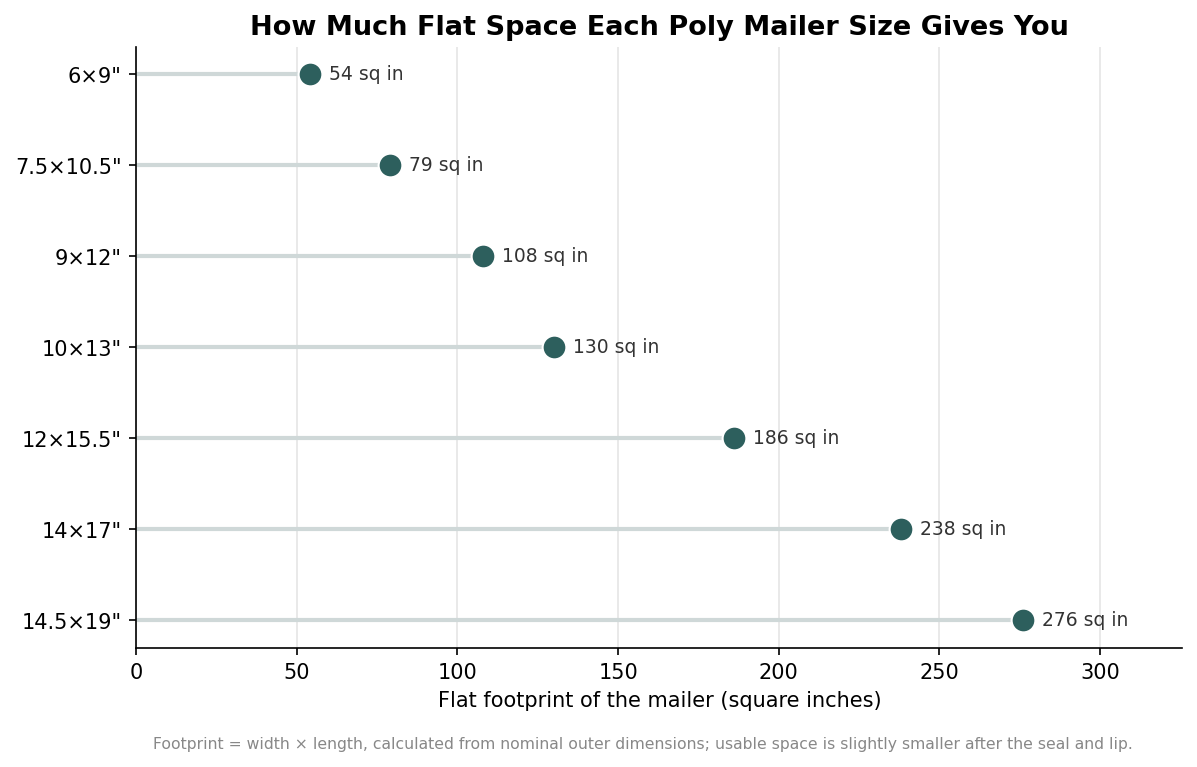
    It is tempting to buy one large size and use it for everything, but oversizing costs money on both ends. A garment rattling around in a bag twice its footprint invites creasing and folding damage, and it inflates the parcel’s dimensions right when carriers are measuring them. Under dimensional-weight pricing, a light item in an unnecessarily large mailer can be billed as though it were heavier, quietly raising the per-parcel cost across thousands of shipments. The flat-footprint view below shows how quickly the usable area grows as you step up, which is the same reason an oversized bag wastes both film and postage. The right move is to carry two or three sizes that cover the bulk of your catalog rather than one catch-all.

    Dot plot of the flat footprint in square inches for each standard poly mailer size
    Flat footprint grows quickly with each size step, which is why oversizing wastes both film and postage.

    Multi-item orders, thickness, and custom dimensions

    When a single order contains several garments, add the packed thickness of the stack before you apply the formula, because depth is what fails first. Two folded hoodies together can push past the seal capacity of a bag that handles either one alone, so the honest answer for heavier bundles is usually to move up a size and up in film thickness rather than to force the fill. For weight, a 2 mil film suits light documents and accessories, 2.5 mil is the common standard for apparel and soft goods, and 4 to 6 mil is worth the upgrade once contents pass a couple of pounds or include anything with a corner or edge.

    Off-the-shelf sizes cover most catalogs, but if your product consistently falls between two standard bags, a custom dimension pays for itself by trimming both film waste and dimensional weight on every parcel. Minimum order quantities and lead times vary by printer and by whether you are adding branding, so it is worth confirming those specifics against real quantities before committing. It also helps to order a small sample run in your two most likely sizes and pack a few real orders by hand before you commit to thousands of units, since the way your specific product folds often settles the question faster than any chart can.

    Once you have landed on a size, write it into your packing standard alongside the film thickness and the fold method, so that whoever packs the order reaches for the same bag every time. Consistency at the packing bench is what turns a good size choice into predictable postage and a predictable unboxing experience, and it is what keeps a growing catalog from quietly drifting back toward the one oversized bag that started the problem. The goal is not the cheapest bag or the biggest bag, but the smallest one that clears the headroom formula for the items you ship most.

  • How Poly Mailer Size and Weight Decide Your Shipping Cost in 2026

    How Poly Mailer Size and Weight Decide Your Shipping Cost in 2026

    The price on a poly mailer is a rounding error next to what you pay to ship it. For most e-commerce brands, postage is the largest recurring packaging cost, and the single factor that quietly drives it is dimensional weight, the pricing rule that bills you for the space a parcel occupies rather than what it actually weighs. Choosing the right mailer, and packing it flat, is one of the few levers that lowers that number on every order you ship.

    How dimensional weight actually works

    Carriers calculate a parcel’s dimensional weight by multiplying length by width by height and dividing by a fixed number called the DIM divisor. They then bill you for whichever is greater, the actual scale weight or that dimensional weight. A light but bulky parcel gets charged as if it were heavy, which is the whole point of the rule: it discourages shipping air.

    Two details make the math less forgiving than it used to be. UPS and FedEx apply a divisor of 139 to essentially every ground shipment, and as of July 12, 2026, USPS moved its own divisor from 166 to 139 to match, across Priority Mail, Priority Mail Express, Ground Advantage, and Parcel Select. USPS also began rounding every fractional dimension up to the next whole inch, so a box measured at 12.2 by 10.8 by 6.1 inches is now calculated as 13 by 11 by 7 before the division. Both changes push billable weight upward for anything with real volume.

    USPS’s cubic-foot rule is the mailer’s advantage

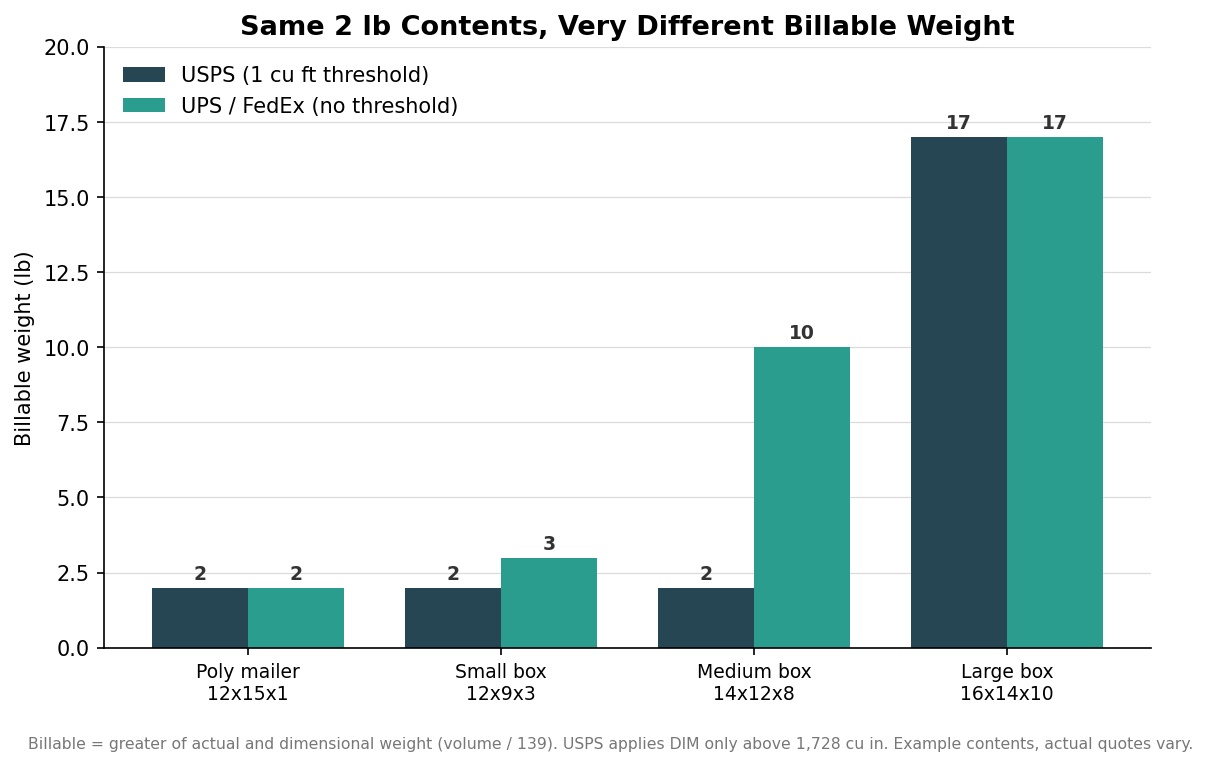
    Here is the part that works in a poly mailer’s favor. USPS applies dimensional weight only to parcels larger than one cubic foot, which is 1,728 cubic inches. Stay at or below that volume and USPS bills you on actual weight alone, no matter how the divisor changes. A flexible poly mailer holding a folded garment compresses to almost nothing and sits far under that threshold, so it ships at its true weight. A rigid box holding the same item keeps its full cubic volume whether it is packed tight or half empty, and once it crosses one cubic foot the dimensional weight takes over.

    Grouped bar chart comparing USPS and UPS/FedEx billable weight for the same 2 pound contents in a poly mailer versus small, medium, and large boxes
    For identical light contents, a poly mailer holds billable weight down on every carrier while boxes climb with volume.

    The comparison is stark for the same lightweight contents. A poly mailer and a small box both stay under the USPS threshold and bill at actual weight, but ship that box by UPS or FedEx, which have no free threshold, and its volume alone can push billable weight to several pounds. Move up to a large box and both USPS and the private carriers charge it as a heavy parcel even though the contents never changed. The mailer is the only option that stays cheap on every carrier.

    The 2026 divisor change raised the stakes

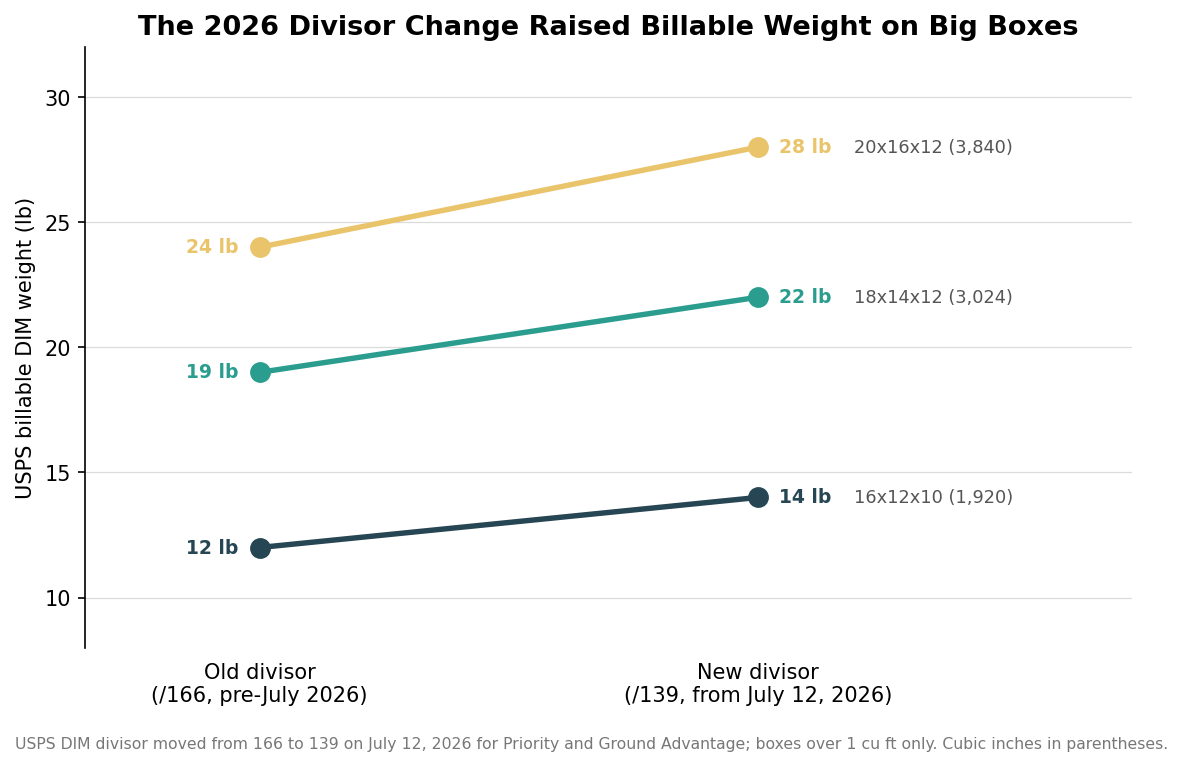
    For any parcel that does cross into dimensional-weight territory, the July 2026 divisor cut from 166 to 139 is a direct cost increase, because a smaller divisor produces a larger billable weight from the same volume. A box around 16 by 12 by 10 inches that billed at roughly 12 pounds under the old divisor now bills at about 14, and a 20 by 16 by 12 carton jumps from the mid-20s into the high-20s of pounds. Nothing about the shipment changed except the arithmetic.

    Slope chart showing USPS billable dimensional weight rising for three box sizes when the divisor changed from 166 to 139 in July 2026
    The July 2026 shift from a 166 to a 139 divisor raised billable weight on every over-threshold box.

    Combined with the round-up rule, the practical effect is that oversized and loosely packed boxes are more expensive than they were a year ago, while right-sized mailers are largely insulated because they never reach the threshold in the first place. If a meaningful share of your volume still goes out in boxes that are bigger than the product needs, that is now a more expensive habit than it used to be.

    How to keep parcels on the cheap side

    Start by matching the mailer to the product rather than keeping one large size for everything. A mailer that is only slightly bigger than the item packs flatter, weighs less, and looks more professional than a half-empty one. When something is soft or foldable, a mailer almost always beats a box on billable weight, so reserve boxes for genuinely rigid or fragile goods that need the structure.

    Pack to minimize volume, not just to fill space. Fold apparel flat, squeeze out trapped air, and avoid oversized fill that puffs a mailer into box-like dimensions. Weigh and measure a real, packed parcel before you commit to a size, and remember that any fraction of an inch now rounds up, so trimming a bulging mailer down below the next whole inch can save a billable pound. Finally, compare carriers for your typical parcel, since USPS’s cubic-foot threshold can make it the cheaper choice for compact mailers even where a private carrier wins on heavier freight. The rates and rules cited here reflect the 2026 USPS changes; confirm current pricing with your carrier before building it into your unit economics, since postage schedules change regularly.

    Why a dollar per parcel is the real number

    The reason dimensional weight deserves this much attention is that the differences are small per order and enormous in aggregate. A single billable pound might separate a mailer from a box on a given shipment, worth perhaps a dollar or two depending on zone and service. That barely registers on one order. Multiply it across a few thousand shipments a month, though, and the same packaging decision swings your postage by thousands of dollars a year, with no change to the product, the price, or the customer experience. It is one of the rare cost levers that improves margin without asking the buyer to pay more.

    Before a new product goes live, run its actual packed parcel through a carrier rate check in both a mailer and a box, at the zones you ship most, and let the billable weight decide rather than habit. Record the mailer size that wins alongside the SKU so packers are not guessing, and revisit the comparison whenever carriers announce a rate or rule change, since a threshold or divisor move can flip which option is cheaper overnight.

  • Recycled vs. Compostable Poly Mailers: A Sustainability Guide

    Recycled vs. Compostable Poly Mailers: A Sustainability Guide

    Two mailers can both wear a green leaf on the front and mean completely different things by it. One is made from recycled plastic and is meant to be recycled again; the other is made from plant-based polymers and is meant to be composted. They are not interchangeable, they fail in different ways, and putting the wrong end-of-life instruction on your packaging is one of the easier ways to lose a customer’s trust. This is a plain-language guide to what recycled and compostable poly mailers actually are, which certifications carry weight, and how to choose the one that fits how your customers really dispose of things.

    Two different green claims that solve different problems

    The first thing to separate is “recycled” from “compostable,” because they answer different questions. Recycled is about where the material came from: a recycled poly mailer is made partly or entirely from post-consumer plastic that would otherwise be waste, and it stays in the plastics stream, ideally getting recycled again. Compostable is about where the material goes: a compostable mailer is made from plant-based polymers designed to break down into compost under the right conditions, and it is meant to leave the plastics stream entirely. A recycled mailer is not compostable, and a compostable mailer generally should not go in plastic recycling, so the two claims point your customer toward opposite bins.

    Recycled poly mailers: post-consumer content and store drop-off

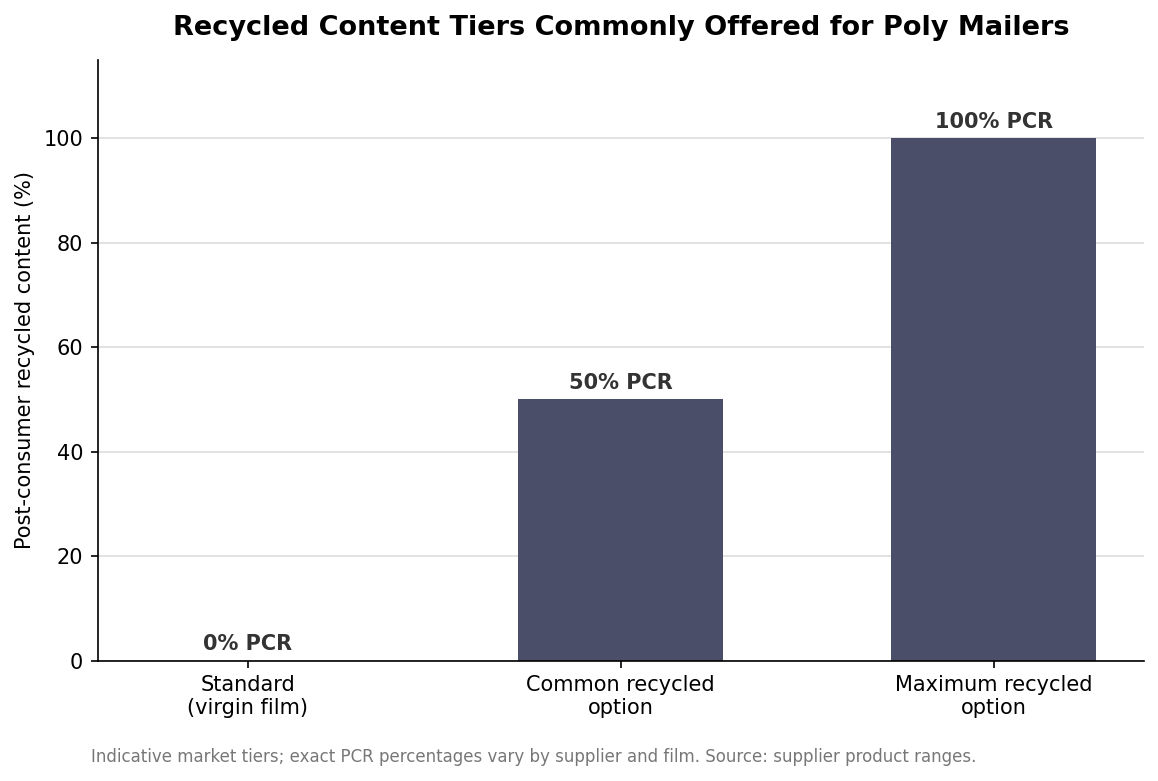
    A recycled poly mailer is a conventional polyethylene mailer that swaps some or all of its virgin plastic for post-consumer recycled content, often abbreviated PCR. Suppliers commonly offer tiers, with a widely available option around 50 percent recycled content and premium films reaching 100 percent, though the exact percentage varies by supplier and product and is worth confirming on the spec sheet rather than assuming. Higher recycled content is the meaningful lever here: it reduces the amount of new plastic produced without changing how the mailer performs in shipping, since recycled polyethylene protects a product just as well as virgin film.

    The catch is disposal. Thin-film mailers, recycled or not, are usually not accepted in curbside recycling because they jam the sorting machinery at most facilities. The correct path is store drop-off: the same bins at grocery and retail stores that take plastic grocery bags accept clean polyethylene film, which is resin identification code 4. A mailer that carries the “Store Drop-Off” instruction under the How2Recycle label is telling your customer exactly that. If you sell recycled mailers as recyclable, print that drop-off instruction, because a customer who tosses the mailer in their curbside bin in good faith is not actually recycling it.

    Bar chart of post-consumer recycled content tiers commonly offered for poly mailers
    Recycled mailers are sold in content tiers; higher post-consumer content is the meaningful lever.

    Compostable mailers: what they are made of and which certifications matter

    Compostable mailers are not plastic in the everyday sense. They are typically built from PLA, a polylactic acid derived from corn starch or sugarcane, blended with PBAT, a flexible polymer that gives the film its stretch, and sometimes plant starches from sources like potato or tapioca. Under the heat and microbial activity of a composting environment, these materials break down into water, carbon dioxide, and biomass rather than persisting as microplastics.

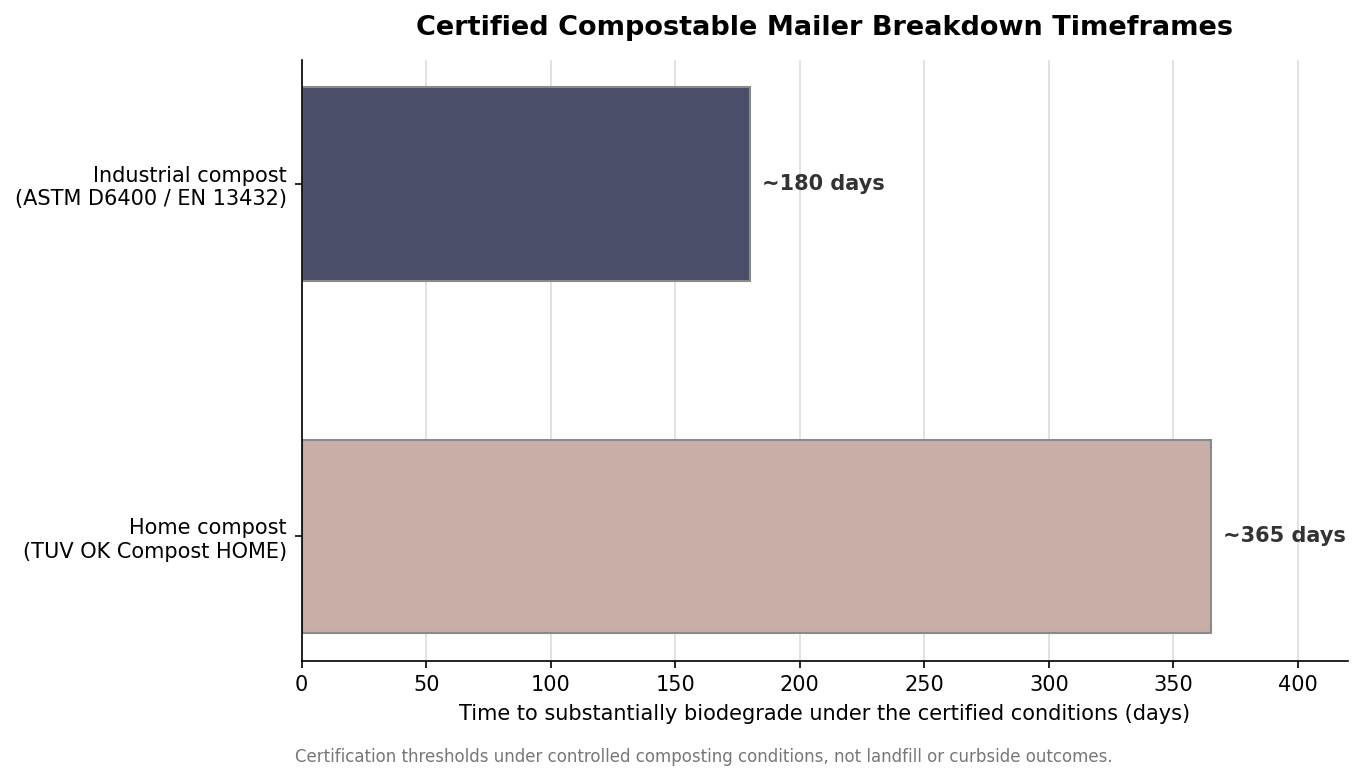
    Certifications are what separate a genuine compostable mailer from a vague “biodegradable” claim, which on its own means very little. In the United States, the relevant standard is ASTM D6400, verified by BPI certification; in Europe the equivalent is EN 13432. Both require that a certified product substantially biodegrade, on the order of 90 percent, within about 180 days under industrial composting conditions. Crucially, that means a high-heat municipal composting facility, not a backyard pile. A separate and stricter mark, TÜV OK Compost HOME, certifies that a mailer will break down in a home compost bin at lower temperatures, typically over a longer window of up to a year. If your customers are unlikely to have access to industrial composting, a home-compostable certification is the claim that actually matches their reality.

    Bar chart of certified compostable mailer breakdown timeframes for industrial and home composting
    Certification thresholds assume proper composting conditions, which not every customer can access.

    Trade-offs: shelf life, moisture, cost, and matching the choice to your customer

    Compostable films buy their end-of-life benefit with some practical compromises. Because they are engineered to break down, they are more sensitive to heat, humidity, and time than conventional polyethylene, so they have a shorter usable shelf life and can weaken if stored for a long stretch in a hot, damp warehouse. They also tend to be less forgiving of moisture in transit and generally cost more per unit than standard or recycled poly. None of that makes them a bad choice; it makes them a choice that needs matching to your product and storage, especially for items that ship quickly and reach customers who compost.

    The honest way to decide is to think about what your customer will actually do with the mailer, not what sounds greenest on a product page. If your audience is urban and recycling-minded but has no composting access, a high recycled-content mailer with a clear store drop-off instruction does more real good than a compostable mailer that ends up in a landfill, where it will not break down the way it does in a compost facility. If your audience genuinely composts, or your city has municipal composting, a certified compostable mailer can be a strong fit. Whichever you choose, print the correct disposal instruction on the mailer, keep the certification marks you are entitled to use and no others, and avoid unqualified words like “eco-friendly” or “biodegradable” that regulators and customers increasingly discount. Matching the claim to the real end-of-life pathway is what turns sustainable packaging from a marketing line into something that actually reduces waste.

  • Poly Mailer vs Bubble Mailer: Which One Protects and Ships Better

    Poly Mailer vs Bubble Mailer: Which One Protects and Ships Better

    The choice between a poly mailer and a bubble mailer is really a choice between two things you cannot have at once: the lowest possible shipping weight, or built-in cushioning. Everything else follows from that trade. Pick the wrong one and you either pay to ship air you did not need or you send a fragile item out in a bag that cannot protect it. Here is how the two compare on the terms that actually change your cost and your damage rate.

    The core difference in one sentence

    A poly mailer is a single skin of coextruded plastic film, usually somewhere between 2 and 4 mil thick, with no padding. A bubble mailer is an envelope lined with a layer of air-pocket cushioning, wrapped in either kraft paper, a poly skin, or vinyl. The poly mailer keeps water, dust, and abrasion off your product and resists tearing. The bubble mailer does all of that too, but adds a cushion between the outside world and whatever is inside. That single added layer is the entire reason to reach for one over the other, and it is also the reason the bubble mailer costs more to buy and more to ship.

    Weight is what decides your shipping bill

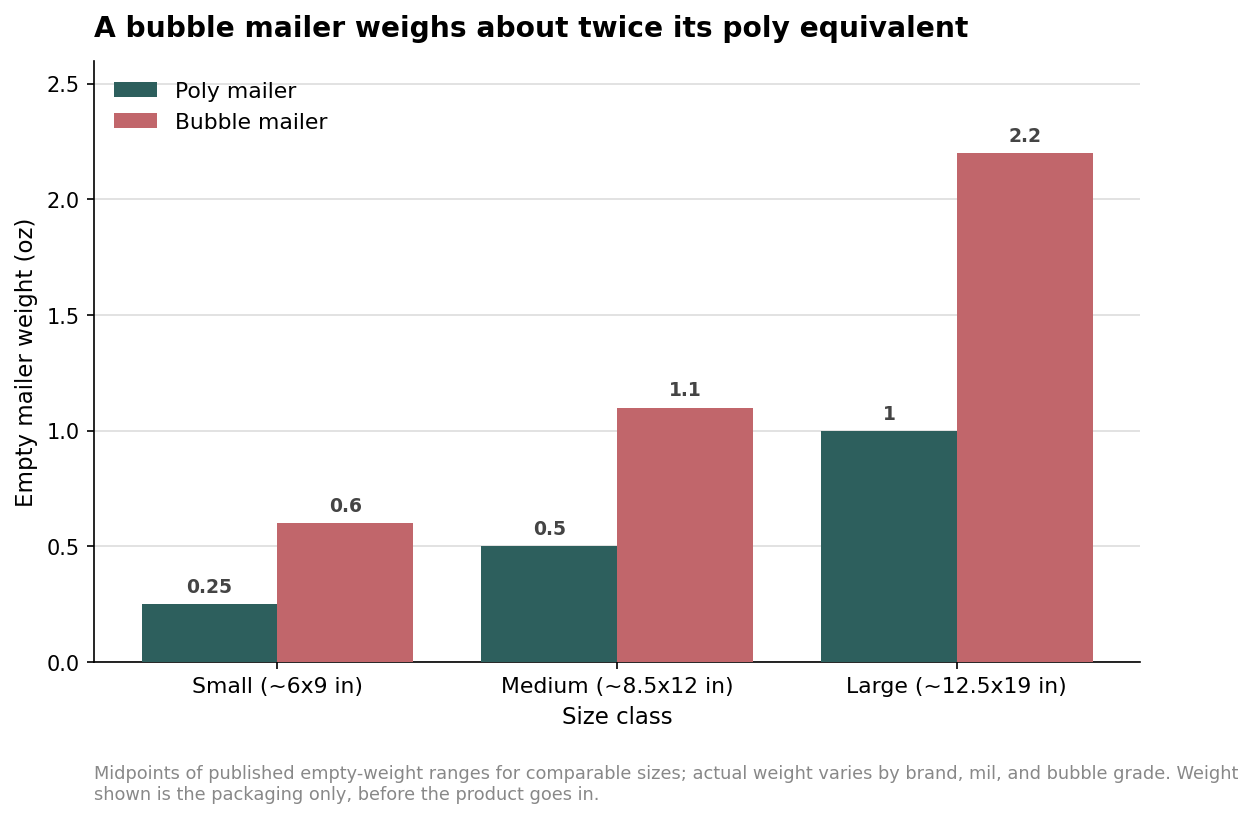
    Empty, the two are not close. Across comparable sizes a bubble mailer runs roughly double the weight of the poly mailer it would replace, because the cushioning and its backing are extra material you are paying to move.

    Grouped bar chart comparing empty weight of poly mailers and bubble mailers across small, medium, and large sizes
    Across comparable sizes, a bubble mailer weighs roughly twice its poly-mailer equivalent.

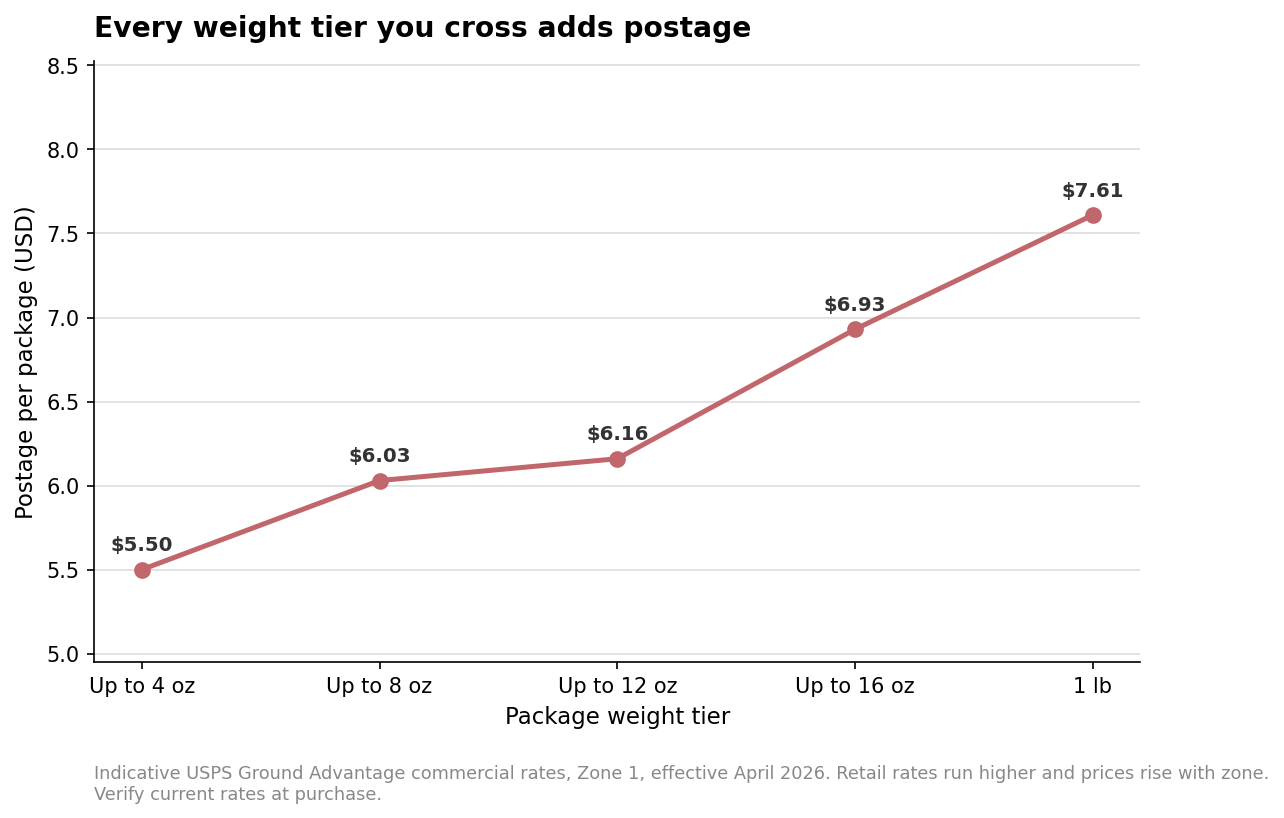
    A quarter of an ounce here and an ounce there sounds trivial until you multiply it across a fulfillment operation. Carrier pricing is banded by weight, so the cost of those extra grams is not linear. It is a cliff. USPS Ground Advantage, the workhorse service for light e-commerce parcels, charges more each time your package crosses into the next tier.

    Line chart of USPS Ground Advantage postage rising with each package weight tier from 4 ounces to 1 pound
    Postage steps up at each weight band, so packaging weight can push a light order into a higher tier.

    Read the two charts together and the mechanism is clear. If your product plus a poly mailer lands at 7.8 ounces, swapping to a bubble mailer that adds three-quarters of an ounce can push the same shipment past the 8-ounce line and into a higher band. On a light, high-volume SKU that is a per-order tax you pay forever. For soft goods that do not need cushioning, the poly mailer is not just cheaper stock, it keeps you in a lower postage tier.

    Protection: what each actually guards against

    It is worth being precise about what “protection” means, because a poly mailer is not unprotected. Its film shields the contents from rain, spills, dirt, and scuffing, and a 3 to 4 mil bag resists puncture and tearing well enough for most apparel and textile shipments. What it does not do is absorb impact. Drop a poly-bagged item on a hard floor and the item takes the full shock. A bubble mailer’s air layer flattens under impact and spreads the force out, which is exactly what a small fragile or hard-edged item needs. The distinction is abrasion and moisture protection, which both offer, versus shock and crush protection, which only cushioning provides.

    What belongs in each

    Soft, unbreakable goods are the poly mailer’s home: t-shirts and apparel, fabric, plush items, linens, and most accessories that cannot be dented or cracked. They flex with the bag, they do not need cushioning, and they benefit most from the weight savings. Small hard or fragile items are the bubble mailer’s territory: electronics and accessories, jewelry, cosmetics in glass, ceramics, and collectibles such as trading cards or coins where a bent corner is a returned order. A useful in-between move is to ship in a custom poly mailer but add a slim internal cushion, a folded sheet of bubble or a thin foam pouch, only for the SKUs that need it. That keeps one branded outer bag across your whole catalog while giving the fragile items the protection they require.

    Branding and the unboxing moment

    If the outside of the parcel is part of your brand, the poly mailer is the better canvas. Its smooth film takes edge-to-edge printing cleanly, so a custom design, full-bleed color, and a logo all reproduce sharply. Bubble mailers are harder to print vividly because the quilted surface and the kraft or coated face fight fine detail, and full-coverage art tends to look muted. That does not mean bubble mailers cannot be branded, but if a striking printed exterior matters to you, poly gives you more to work with per dollar. There is also a disposal angle worth a mention: a plain poly mailer is a single film material that is often accepted at store film-recycling drop-offs, while a bubble mailer’s mixed paper-and-plastic construction is frequently harder to recycle. Recycling acceptance varies by locality, so treat that as a general tendency rather than a guarantee.

    The practical call

    Most direct-to-consumer brands do not choose one mailer for everything. They standardize on a custom-printed poly mailer as the default for the bulk of their catalog, which is usually soft goods, and keep a bubble or padded option on hand for the specific fragile SKUs that justify the extra weight and cost. That approach gives you the cheapest, lightest, best-branded option where it fits, and reserves cushioning for the orders that would otherwise come back damaged. Start from the product: if it cannot be dented, cracked, or crushed, ship it in poly and put the savings toward the design on the outside. If it can, either move that SKU to a bubble mailer or add a cushioning insert, and let the rest of your catalog stay light.

  • A DTC Brand’s Guide to Poly Mailer Margins — Customized Poly Mailers

    Call or Text us: (929) 605-4397

    HomeBlog › A DTC Brand’s Guide to Poly Mailer Margins

    Economics

    A DTC Brand’s Guide to Poly Mailer Margins

    06/30/2026

    Packaging is a line item that’s easy to either ignore or over-invest in. Get it right and a custom poly mailer adds meaningful brand value for a few cents per order. Get it wrong and it quietly erodes margin across thousands of shipments a month.

    Here’s how to think about poly mailer cost as part of your unit economics, not just a packaging decision.

    Where the real cost sits

    Per-unit mailer cost is only part of the picture. The bigger lever is often shipping cost: because poly mailers are dramatically lighter than boxes, many brands see their per-order shipping cost drop enough to more than offset the incremental cost of custom printing versus a plain mailer.

    Volume tiers change the math

    Order quantityRelative unit costNote
    500 (MOQ)Highest per-unitGood for testing a new size or finish
    2,000-5,000ModerateTypical reorder size for growing DTC brands
    10,000+Lowest per-unitBest economics; requires storage planning

    Most brands find their sweet spot somewhere in the 2,000-5,000 range — large enough to meaningfully lower unit cost, small enough not to tie up working capital or warehouse space for six months.

    Don’t let format creep erode the savings

    It’s tempting to add bubble lining or a jumbo size across the board once you see how well a premium mailer performs. Reserve the upgraded formats for the SKUs that actually need them — fragile items, bulky orders — and keep your default order on the Standard Poly Mailer to protect your blended unit cost.

    Building it into your P&L

    Treat packaging as a per-order cost alongside pick-and-pack labor and shipping, not a separate marketing expense. Once it’s in the same line as fulfillment cost, it’s easier to see that a well-specified mailer program often pays for its branding upgrade through lighter-weight shipping savings alone.

    Key takeawayOrder in the 2,000-5,000 range for the best blended unit cost, and reserve premium formats like bubble-lined or jumbo for the SKUs that actually need them to protect your margin.

    Ready to run the numbers on your own program? Get a custom quote — free mockups in 24–48 hours. Learn more about how we work, or browse more guides.

    More posts

  • How to Order Custom Poly Mailers: A Step-by-Step Checklist — Customized Poly Mailers

    Call or Text us: (929) 605-4397

    HomeBlog › How to Order Custom Poly Mailers: A Step-by-Step Checklist

    Ordering

    How to Order Custom Poly Mailers: A Step-by-Step Checklist

    05/26/2026

    Ordering custom poly mailers for the first time involves a handful of decisions that are easy to get right if you make them in order. Here’s the checklist we walk every new customer through.

    Work through these five steps before you request your quote and the whole process moves faster.

    1. Confirm your artwork

    Vector files (AI, EPS, SVG, or PDF) print cleanest. If you only have a PNG or a photo of your logo, that’s fine — our designers will recreate it print-ready at no charge, but flag it up front so we can plan for the extra design step.

    2. Pick a size that fits your typical order

    Measure your most-shipped product folded or boxed down to its shipping size, then add a small margin. Oversizing wastes money on unused film; undersizing forces overstuffing, which is the top cause of tears.

    3. Choose mil thickness and format

    Standard 2.5 mil for light, folded goods. 3.5 mil or Bubble-Lined for anything heavier or fragile. Double-Drawstring if returns are a meaningful share of your volume. Jumbo if you regularly ship multi-item or bulky orders.

    4. Decide print placement and colors

    Outside print for brand visibility, inside print for a plain exterior. Confirm your Pantone colors if you need an exact brand match rather than a close approximation.

    StepWhat to have readyTypical timing
    1. ArtworkVector logo file or reference imageBefore requesting a quote
    2. MockupSize, thickness, and print placement decided24–48 hours after request
    3. ApprovalSign off on the mockupAs soon as you’re ready
    4. ProductionNothing further needed~2 weeks

    5. Set a realistic in-hands date

    Add mockup and revision time to the two-week production window, plus shipping. For a firm launch date, request rush production early — it’s easier to accommodate with notice.

    Ordering with confidence

    Most delays come from artwork not being ready or sizing decisions made too late. Nail down steps 1 through 3 before you request your quote, and the rest of the process moves in a straight line to your in-hands date.

    Key takeawayLock in your artwork, size, and mil thickness before requesting a quote — those three decisions determine almost everything else about your timeline.

    Ready to start your order? Get a custom quote — free mockups in 24–48 hours. Learn more about how we work, or browse more guides.

    More posts

  • Do Poly Mailers Tear? A Durability Comparison — Customized Poly Mailers

    Call or Text us: (929) 605-4397

    HomeBlog › Do Poly Mailers Tear? A Durability Comparison

    Durability

    Do Poly Mailers Tear? A Durability Comparison

    05/08/2026

    Brands switching from boxes to poly mailers almost always ask the same question first: will it hold up? It’s a fair concern — a mailer that splits open in a mail truck is worse than no branding at all. Here’s how poly mailers actually compare to the alternatives.

    Coextruded poly film, the material behind every mailer we produce, is engineered specifically for shipping stress: it flexes instead of creasing, resists puncture better than most people expect, and sheds water outright rather than absorbing it.

    Poly mailers vs. corrugated boxes

    A box resists crushing better than a mailer, which matters for rigid or stackable contents, but a box is also more prone to corner damage and moisture absorption if it sits in rain or snow. A properly specified poly mailer — right mil thickness for the contents’ weight — rarely tears under normal handling and is fully waterproof.

    Poly mailers vs. paper/kraft mailers

    Paper mailers tear far more easily at corners and seams, and they have no water resistance at all — a paper mailer left in wet weather can fail completely. Poly mailers hold their shape and integrity in conditions that would ruin a paper equivalent.

    FactorPoly mailerCorrugated boxPaper mailer
    Tear resistanceHighMedium (crushable)Low
    Water resistanceFullPoor (unless coated)None
    Weight/shipping costLowestHighestLow
    Best forSoft goods, most DTC ordersRigid or stackable itemsLight, low-value items

    What actually causes failures

    In our experience, mailer failures almost always trace back to one thing: using too thin a film for the contents’ weight, not the material itself. A 2.5 mil mailer stuffed past its comfortable capacity is far more likely to split than a properly sized 3.5 mil mailer carrying the same load.

    Choosing for durability

    Match mil thickness to your typical order weight, use a Bubble-Lined mailer for anything fragile, and step up to Jumbo sizing rather than overstuffing a standard mailer. Done right, a poly mailer is one of the most durable packaging formats available for soft and light-to-medium goods.

    Key takeawayProperly sized poly mailers outperform paper mailers on every durability metric and beat boxes on water resistance and shipping cost — most failures come from underspecifying film thickness, not the material itself.

    Not sure which thickness fits your product? Get a custom quote and we’ll recommend one — free mockups in 24–48 hours. Learn more about how we work, or browse more guides.

    More posts

  • Poly Mailers for Subscription Boxes and Beauty Brands — Customized Poly Mailers

    Call or Text us: (929) 605-4397

    HomeBlog › Poly Mailers for Subscription Boxes and Beauty Brands

    Audience guide

    Poly Mailers for Subscription Boxes and Beauty Brands

    04/19/2026

    Subscription and beauty brands live and die by the unboxing moment. Unlike a one-time DTC purchase, a subscription customer opens your package every month, and a beauty customer is often unboxing a product designed to be photographed. Packaging choice matters more here than almost anywhere else in e-commerce.

    Two of our formats come up constantly with these brands: the Frosted Boutique Mailer and the Bubble-Lined Poly Mailer.

    The case for a frosted finish

    A glossy poly mailer reads as purely functional. A frosted, matte finish reads as intentional — closer to a boutique retail bag than a shipping envelope. For a beauty brand shipping a serum or a curated skincare set, or a subscription box brand trying to build monthly anticipation, that visual difference does real work before the box is even open.

    The case for bubble lining

    Beauty products frequently ship in glass or rigid plastic bottles that can crack or scratch in an unlined mailer. A Bubble-Lined Poly Mailer adds real cushioning without the cost or bulk of a box and separate void fill, and it still ships lighter than a comparable boxed shipment.

    NeedBest formatWhy
    Premium unboxing feelFrosted Boutique MailerMatte, soft-touch finish reads elevated
    Fragile or glass productBubble-Lined Poly MailerBuilt-in cushioning, no separate box
    Both premium feel and fragilityFrosted outer, bubble-lined inner insertCombine formats across a multi-item box

    Choosing for your brand

    If your product is durable but your brand story depends on presentation, start with the Frosted Boutique Mailer. If breakage complaints are your bigger problem, start with Bubble-Lined. Many subscription boxes eventually use both — a frosted outer mailer for brand feel, with a bubble-lined inner pouch for a breakable item that rotates in some months.

    Key takeawayChoose the Frosted Boutique Mailer for presentation-first brands and the Bubble-Lined Poly Mailer when breakage protection is the priority — or combine both for a multi-item box.

    Ready to upgrade your unboxing experience? Get a custom quote — free mockups in 24–48 hours. Learn more about how we work, or browse more guides.

    More posts