The price on a poly mailer is a rounding error next to what you pay to ship it. For most e-commerce brands, postage is the largest recurring packaging cost, and the single factor that quietly drives it is dimensional weight, the pricing rule that bills you for the space a parcel occupies rather than what it actually weighs. Choosing the right mailer, and packing it flat, is one of the few levers that lowers that number on every order you ship.
How dimensional weight actually works
Carriers calculate a parcel’s dimensional weight by multiplying length by width by height and dividing by a fixed number called the DIM divisor. They then bill you for whichever is greater, the actual scale weight or that dimensional weight. A light but bulky parcel gets charged as if it were heavy, which is the whole point of the rule: it discourages shipping air.
Two details make the math less forgiving than it used to be. UPS and FedEx apply a divisor of 139 to essentially every ground shipment, and as of July 12, 2026, USPS moved its own divisor from 166 to 139 to match, across Priority Mail, Priority Mail Express, Ground Advantage, and Parcel Select. USPS also began rounding every fractional dimension up to the next whole inch, so a box measured at 12.2 by 10.8 by 6.1 inches is now calculated as 13 by 11 by 7 before the division. Both changes push billable weight upward for anything with real volume.
USPS’s cubic-foot rule is the mailer’s advantage
Here is the part that works in a poly mailer’s favor. USPS applies dimensional weight only to parcels larger than one cubic foot, which is 1,728 cubic inches. Stay at or below that volume and USPS bills you on actual weight alone, no matter how the divisor changes. A flexible poly mailer holding a folded garment compresses to almost nothing and sits far under that threshold, so it ships at its true weight. A rigid box holding the same item keeps its full cubic volume whether it is packed tight or half empty, and once it crosses one cubic foot the dimensional weight takes over.
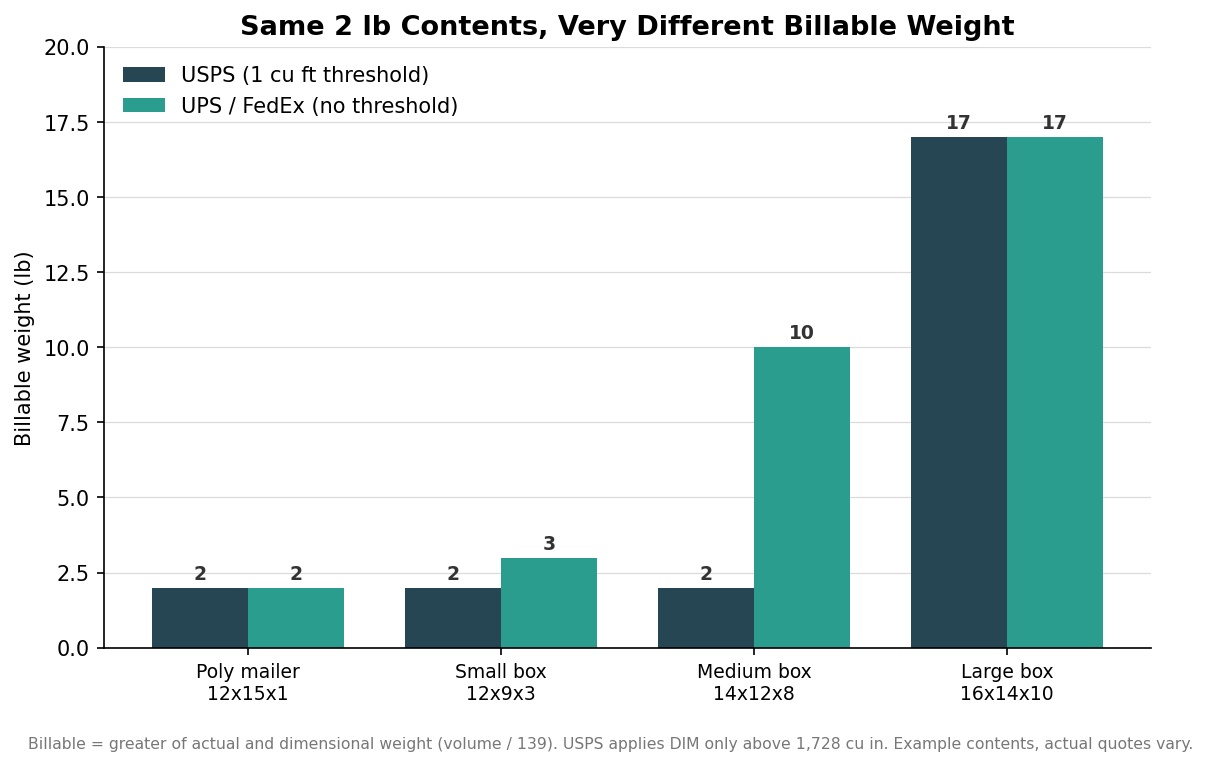
The comparison is stark for the same lightweight contents. A poly mailer and a small box both stay under the USPS threshold and bill at actual weight, but ship that box by UPS or FedEx, which have no free threshold, and its volume alone can push billable weight to several pounds. Move up to a large box and both USPS and the private carriers charge it as a heavy parcel even though the contents never changed. The mailer is the only option that stays cheap on every carrier.
The 2026 divisor change raised the stakes
For any parcel that does cross into dimensional-weight territory, the July 2026 divisor cut from 166 to 139 is a direct cost increase, because a smaller divisor produces a larger billable weight from the same volume. A box around 16 by 12 by 10 inches that billed at roughly 12 pounds under the old divisor now bills at about 14, and a 20 by 16 by 12 carton jumps from the mid-20s into the high-20s of pounds. Nothing about the shipment changed except the arithmetic.
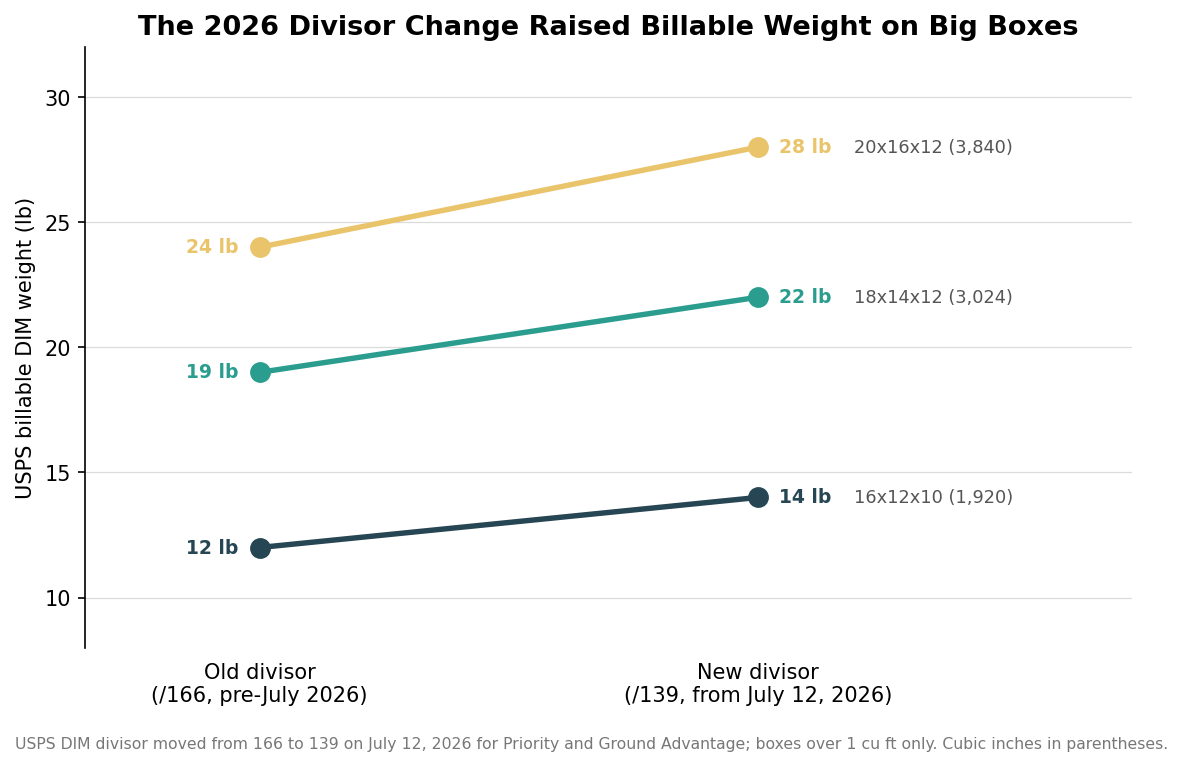
Combined with the round-up rule, the practical effect is that oversized and loosely packed boxes are more expensive than they were a year ago, while right-sized mailers are largely insulated because they never reach the threshold in the first place. If a meaningful share of your volume still goes out in boxes that are bigger than the product needs, that is now a more expensive habit than it used to be.
How to keep parcels on the cheap side
Start by matching the mailer to the product rather than keeping one large size for everything. A mailer that is only slightly bigger than the item packs flatter, weighs less, and looks more professional than a half-empty one. When something is soft or foldable, a mailer almost always beats a box on billable weight, so reserve boxes for genuinely rigid or fragile goods that need the structure.
Pack to minimize volume, not just to fill space. Fold apparel flat, squeeze out trapped air, and avoid oversized fill that puffs a mailer into box-like dimensions. Weigh and measure a real, packed parcel before you commit to a size, and remember that any fraction of an inch now rounds up, so trimming a bulging mailer down below the next whole inch can save a billable pound. Finally, compare carriers for your typical parcel, since USPS’s cubic-foot threshold can make it the cheaper choice for compact mailers even where a private carrier wins on heavier freight. The rates and rules cited here reflect the 2026 USPS changes; confirm current pricing with your carrier before building it into your unit economics, since postage schedules change regularly.
Why a dollar per parcel is the real number
The reason dimensional weight deserves this much attention is that the differences are small per order and enormous in aggregate. A single billable pound might separate a mailer from a box on a given shipment, worth perhaps a dollar or two depending on zone and service. That barely registers on one order. Multiply it across a few thousand shipments a month, though, and the same packaging decision swings your postage by thousands of dollars a year, with no change to the product, the price, or the customer experience. It is one of the rare cost levers that improves margin without asking the buyer to pay more.
Before a new product goes live, run its actual packed parcel through a carrier rate check in both a mailer and a box, at the zones you ship most, and let the billable weight decide rather than habit. Record the mailer size that wins alongside the SKU so packers are not guessing, and revisit the comparison whenever carriers announce a rate or rule change, since a threshold or divisor move can flip which option is cheaper overnight.
Leave a Reply