The choice between a poly mailer and a bubble mailer is really a choice between two things you cannot have at once: the lowest possible shipping weight, or built-in cushioning. Everything else follows from that trade. Pick the wrong one and you either pay to ship air you did not need or you send a fragile item out in a bag that cannot protect it. Here is how the two compare on the terms that actually change your cost and your damage rate.
The core difference in one sentence
A poly mailer is a single skin of coextruded plastic film, usually somewhere between 2 and 4 mil thick, with no padding. A bubble mailer is an envelope lined with a layer of air-pocket cushioning, wrapped in either kraft paper, a poly skin, or vinyl. The poly mailer keeps water, dust, and abrasion off your product and resists tearing. The bubble mailer does all of that too, but adds a cushion between the outside world and whatever is inside. That single added layer is the entire reason to reach for one over the other, and it is also the reason the bubble mailer costs more to buy and more to ship.
Weight is what decides your shipping bill
Empty, the two are not close. Across comparable sizes a bubble mailer runs roughly double the weight of the poly mailer it would replace, because the cushioning and its backing are extra material you are paying to move.
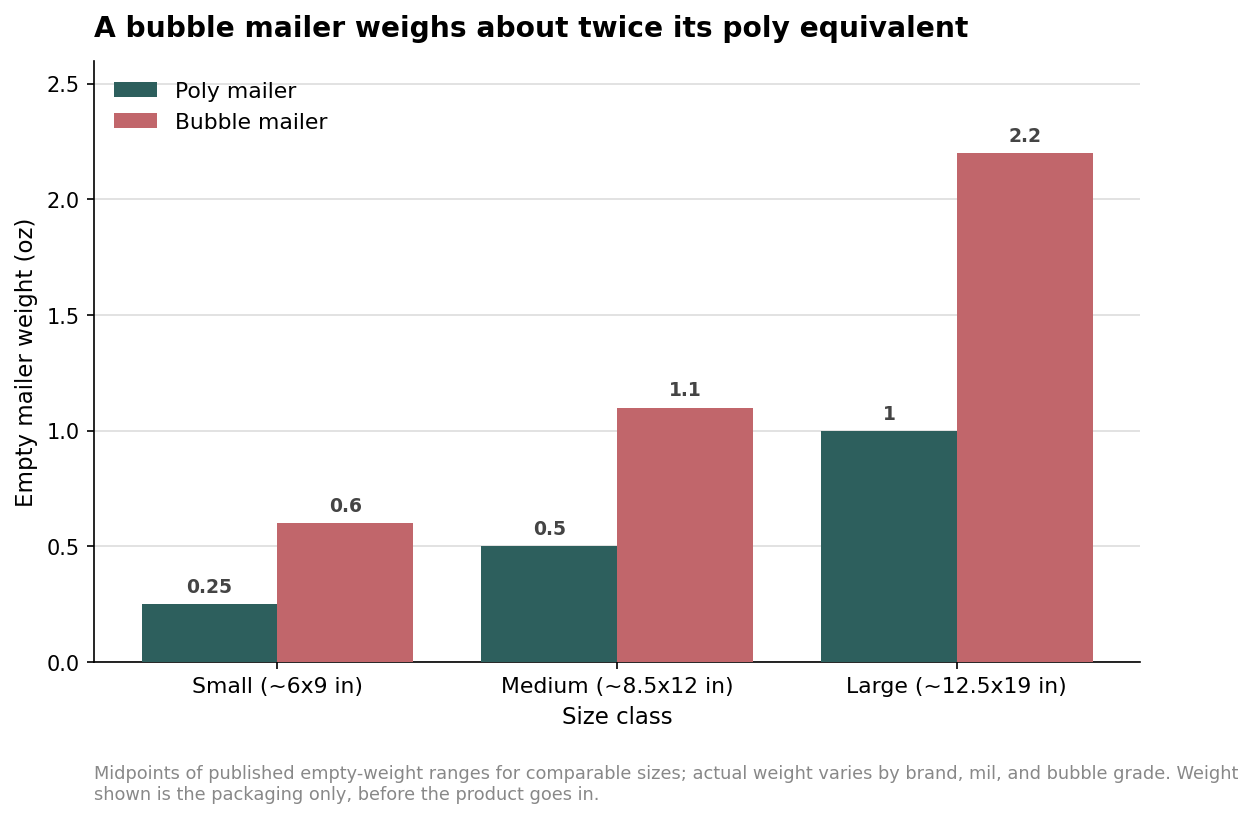
A quarter of an ounce here and an ounce there sounds trivial until you multiply it across a fulfillment operation. Carrier pricing is banded by weight, so the cost of those extra grams is not linear. It is a cliff. USPS Ground Advantage, the workhorse service for light e-commerce parcels, charges more each time your package crosses into the next tier.
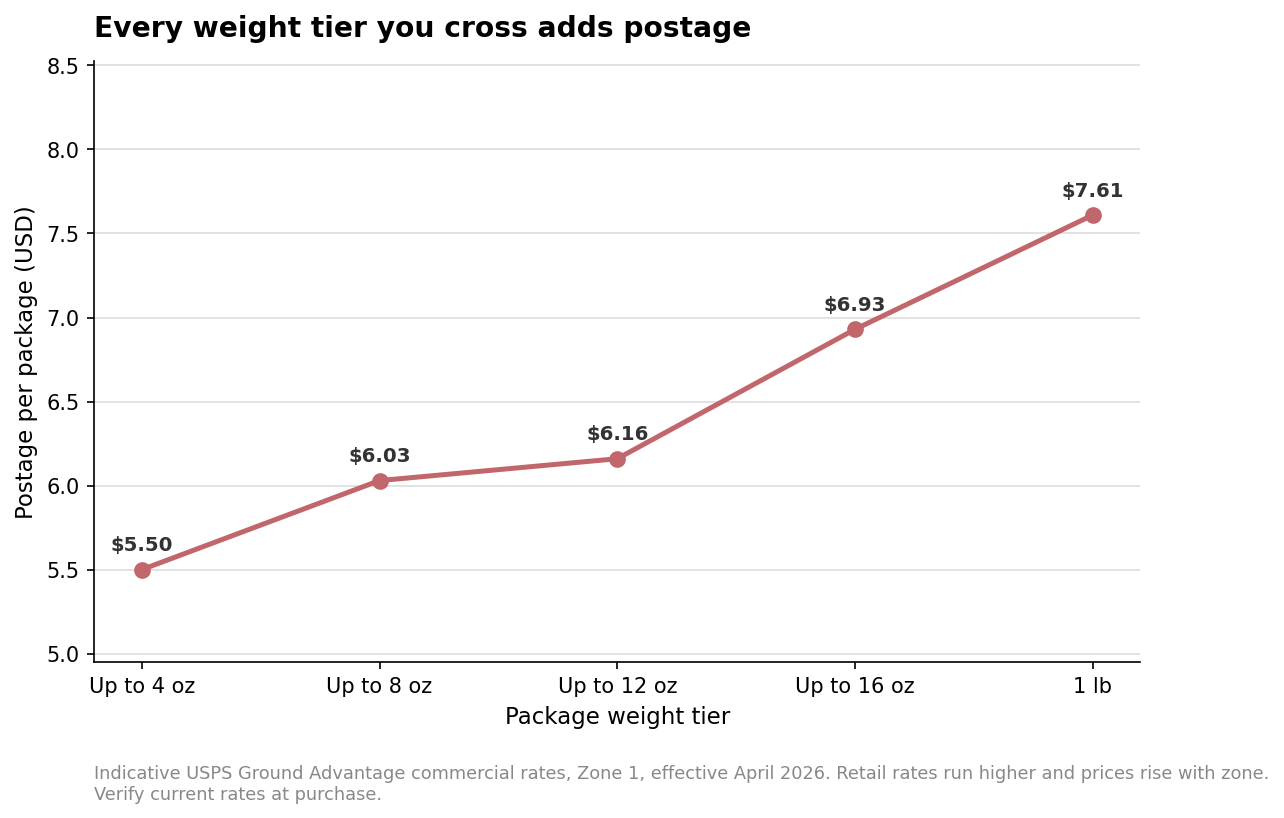
Read the two charts together and the mechanism is clear. If your product plus a poly mailer lands at 7.8 ounces, swapping to a bubble mailer that adds three-quarters of an ounce can push the same shipment past the 8-ounce line and into a higher band. On a light, high-volume SKU that is a per-order tax you pay forever. For soft goods that do not need cushioning, the poly mailer is not just cheaper stock, it keeps you in a lower postage tier.
Protection: what each actually guards against
It is worth being precise about what “protection” means, because a poly mailer is not unprotected. Its film shields the contents from rain, spills, dirt, and scuffing, and a 3 to 4 mil bag resists puncture and tearing well enough for most apparel and textile shipments. What it does not do is absorb impact. Drop a poly-bagged item on a hard floor and the item takes the full shock. A bubble mailer’s air layer flattens under impact and spreads the force out, which is exactly what a small fragile or hard-edged item needs. The distinction is abrasion and moisture protection, which both offer, versus shock and crush protection, which only cushioning provides.
What belongs in each
Soft, unbreakable goods are the poly mailer’s home: t-shirts and apparel, fabric, plush items, linens, and most accessories that cannot be dented or cracked. They flex with the bag, they do not need cushioning, and they benefit most from the weight savings. Small hard or fragile items are the bubble mailer’s territory: electronics and accessories, jewelry, cosmetics in glass, ceramics, and collectibles such as trading cards or coins where a bent corner is a returned order. A useful in-between move is to ship in a custom poly mailer but add a slim internal cushion, a folded sheet of bubble or a thin foam pouch, only for the SKUs that need it. That keeps one branded outer bag across your whole catalog while giving the fragile items the protection they require.
Branding and the unboxing moment
If the outside of the parcel is part of your brand, the poly mailer is the better canvas. Its smooth film takes edge-to-edge printing cleanly, so a custom design, full-bleed color, and a logo all reproduce sharply. Bubble mailers are harder to print vividly because the quilted surface and the kraft or coated face fight fine detail, and full-coverage art tends to look muted. That does not mean bubble mailers cannot be branded, but if a striking printed exterior matters to you, poly gives you more to work with per dollar. There is also a disposal angle worth a mention: a plain poly mailer is a single film material that is often accepted at store film-recycling drop-offs, while a bubble mailer’s mixed paper-and-plastic construction is frequently harder to recycle. Recycling acceptance varies by locality, so treat that as a general tendency rather than a guarantee.
The practical call
Most direct-to-consumer brands do not choose one mailer for everything. They standardize on a custom-printed poly mailer as the default for the bulk of their catalog, which is usually soft goods, and keep a bubble or padded option on hand for the specific fragile SKUs that justify the extra weight and cost. That approach gives you the cheapest, lightest, best-branded option where it fits, and reserves cushioning for the orders that would otherwise come back damaged. Start from the product: if it cannot be dented, cracked, or crushed, ship it in poly and put the savings toward the design on the outside. If it can, either move that SKU to a bubble mailer or add a cushioning insert, and let the rest of your catalog stay light.
Leave a Reply