The single decision that most shapes what a run of custom poly mailers costs is not the film or the size. It is the print method. Flexographic and digital printing produce a similar-looking mailer, but they price the job in completely different ways: one front-loads a fixed setup cost and then makes each mailer very cheap, the other charges almost nothing to start and a bit more per piece. Knowing which curve you are on, and where the two cross, is what keeps a brand from overpaying for its packaging.
What flexographic printing does well
Flexographic printing, usually shortened to flexo, is the workhorse of high-volume film printing. It works by etching your artwork onto flexible relief plates, one plate per spot color, and mounting them on a rotating cylinder that inks a continuous roll of film. Because the plates are a physical, one-time investment, flexo carries a real setup cost before the first good mailer comes off the line. Once the press is running, though, the marginal cost of each additional mailer is very low. That economics makes flexo the right tool when you are ordering in the thousands and printing a small number of solid, consistent colors, such as a wordmark and an accent shade. It reproduces flat brand colors cleanly and holds registration well across a long run.
Where digital printing wins
Digital printing skips the plates entirely. Artwork goes straight from a file to the press, so there is no plate fee and no meaningful setup charge. That changes the math at the low end: a run of a few hundred mailers, or a design with photographic detail and many colors, is usually cheaper and faster digitally. Digital also makes short, frequent reorders practical, which suits a brand that is still testing designs or runs seasonal variants. The trade-off is per-unit cost. Without plates to amortize, the price of each mailer stays relatively flat as volume climbs, so at large quantities digital loses the cost advantage it holds at the bottom.
The volume where the two cross over
Because flexo trades a high starting cost for a low per-piece cost and digital does the opposite, there is a crossover volume where they meet. For film and label work, that break-even typically lands somewhere between 1,000 and 5,000 units, depending on how many colors the design uses and which material you print on. Below the crossover, digital is cheaper because you avoid the plate bill. Above it, flexo pulls ahead and keeps widening its lead as volume grows.
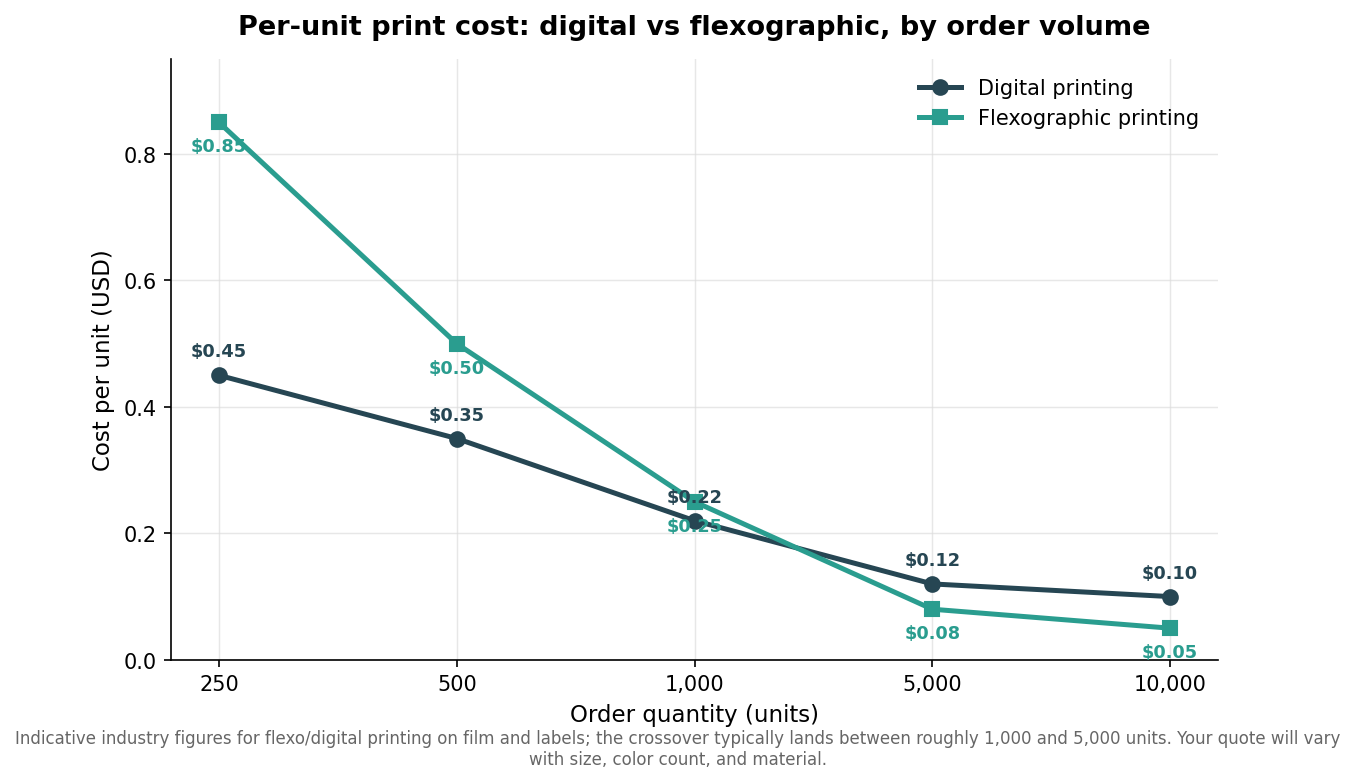
The pattern in the numbers is the point rather than any single figure. At a few hundred pieces, digital can run roughly half the per-unit cost of flexo because flexo is still paying off its plates. By 5,000 pieces the order flips, and at 10,000 and beyond flexo can cost a fraction of the digital price per mailer. If your annual volume sits near the crossover, the tie-breaker is usually reorder behavior: one large flexo run is cheapest per piece, but if you expect to change the art or split the year into several small drops, digital’s zero setup can win on total spend even at moderate volume.
Why color count drives the setup bill
The reason flexo setup is not a single number is that each spot color needs its own plate. Plates commonly run about $50 to $200 per color, plus a design and imaging fee, so a one-color mailer might carry a modest plate charge while a four-color job can reach several hundred dollars before anything prints. Six-color designs push the setup past a thousand dollars. None of that recurs on a reorder of the same art, since the plates already exist, but it is real money on a first run and it is the main lever you control.
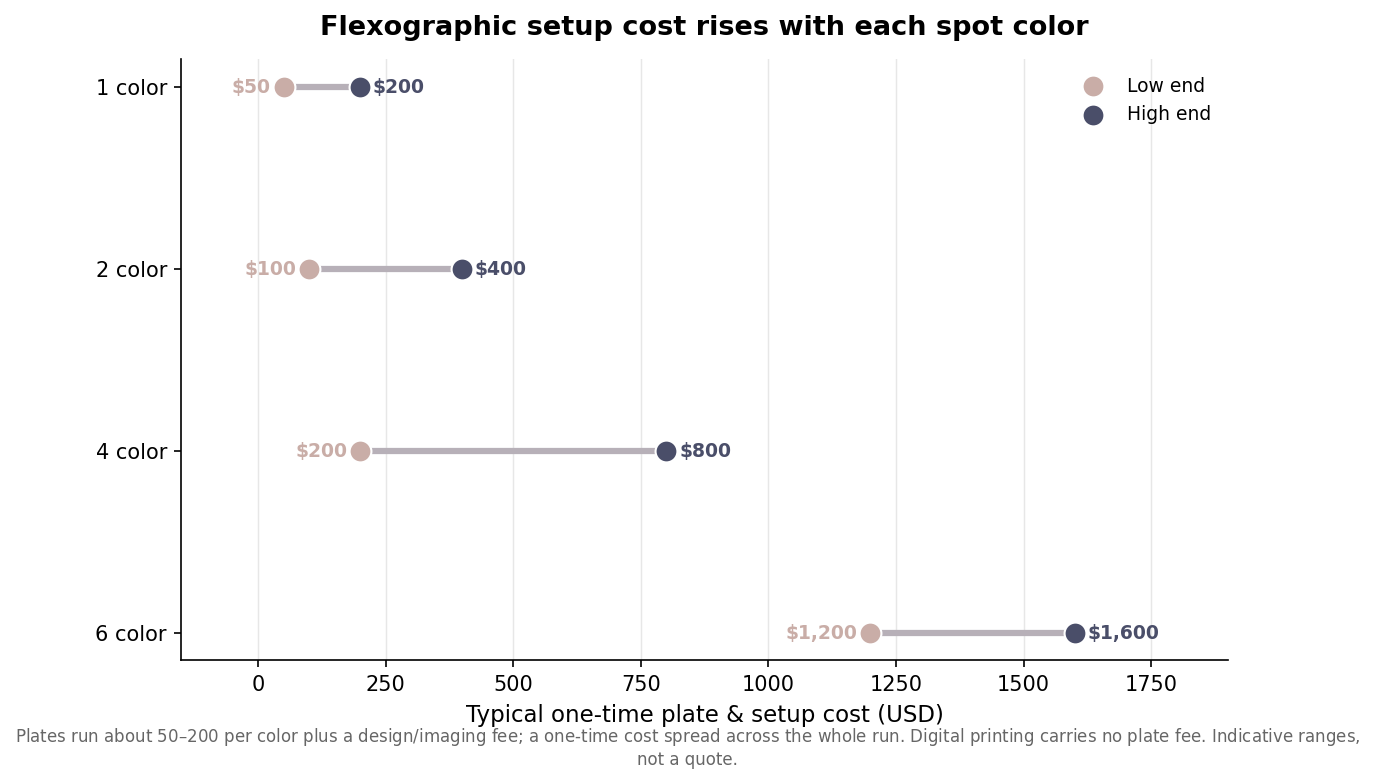
The practical takeaway is to be deliberate about color count when you print flexo. A logo that uses two brand colors instead of four can cut the setup bill roughly in half without materially changing how the mailer looks on a doorstep. If a design genuinely needs full-color imagery or a gradient, that is a strong signal to print digitally, where added colors do not add setup cost at all.
Matching the method to your order
Put the two curves together and a simple decision rule falls out. If you are ordering a large, stable run in a few flat colors, specify flexo and accept the plate cost as a one-time investment that pays for itself over the run. If you are ordering small quantities, testing artwork, printing photographic or many-color designs, or planning frequent short reorders, specify digital and skip the setup entirely. When your volume sits in the 1,000-to-5,000 range, ask your supplier to quote both methods for your exact size, color count, and material, then compare the all-in totals rather than the per-unit prices alone, because the setup fee is what tips the balance.
The figures here are indicative industry ranges rather than a specific quote, and real pricing shifts with mailer dimensions, film thickness, ink coverage, and current material costs. Treat them as a way to understand which side of the crossover you are on, then get a live quote for both methods before committing to a first run. Choosing the method that fits your volume, not just the one your supplier defaults to, is one of the few packaging decisions that can move your per-order cost by a meaningful margin.
Leave a Reply