Choosing a poly mailer size looks trivial until the first batch arrives and the bags are either splitting at the seams or swallowing a single folded shirt in a sea of slack film. The size you pick decides three things at once: whether the product survives the trip, what the package weighs on the carrier’s scale, and how the parcel looks when it lands on a doorstep. This guide works the way real fulfillment does, starting from the item you actually ship and working outward to the bag, with concrete dimensions you can order against.
Start with the item, not the bag
The most common sizing mistake is shopping for a mailer by name rather than by fit. A “10 by 13” sounds standard, but standard for what? Lay the product down the way it will ship, folded as you would fold it for packing, and measure the flat footprint plus its packed thickness. A single cotton tee folds to roughly an eight by ten inch rectangle less than an inch thick; a heavyweight hoodie folded the same way can reach eleven by fourteen inches and two inches thick. Those are the numbers that matter, not the garment’s label size. Once you have the packed dimensions, everything downstream, the bag size, the film thickness, and the postage tier, follows from them.
A size-by-size reference
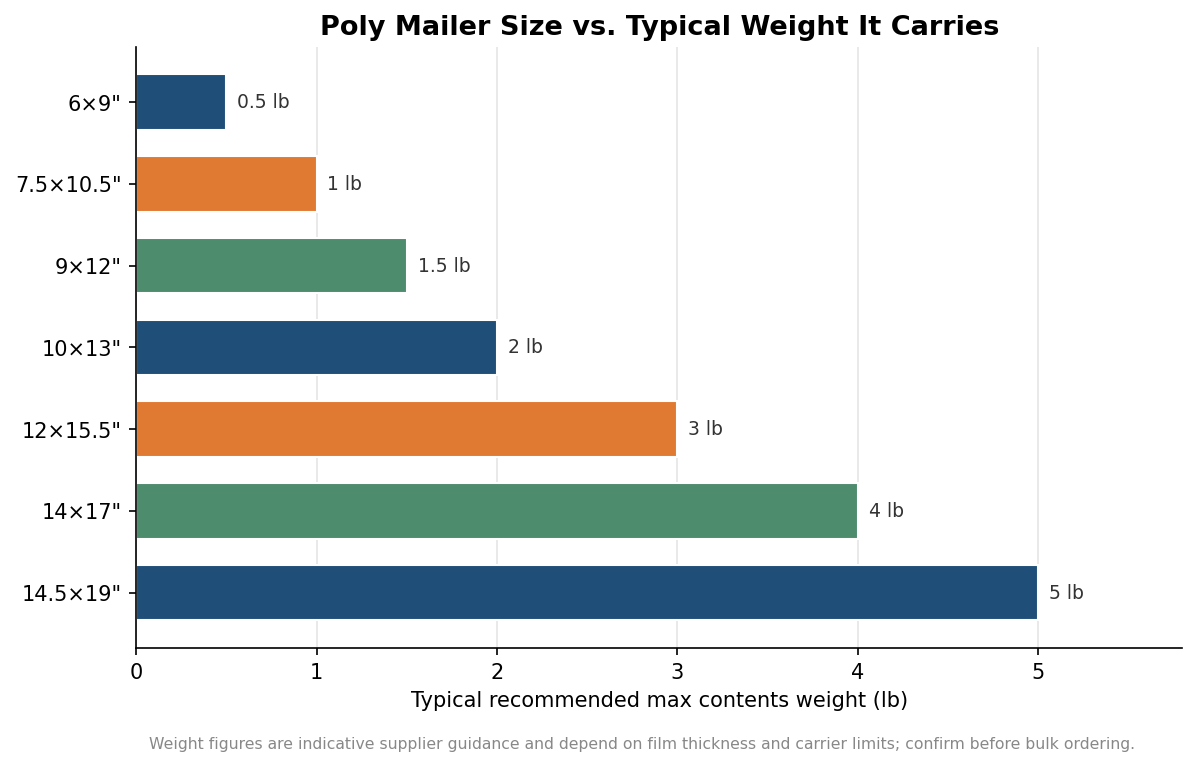
Across most suppliers the poly mailer range runs in fairly consistent steps, and each step has a natural home. The 6 by 9 inch bag is the accessory size: jewelry, phone cases, cables, cosmetics, and other items under roughly half a pound. The 7.5 by 10.5 inch handles a single small garment such as a folded tee, a scarf, or a few pairs of socks, up to about a pound. The 9 by 12 inch is the everyday apparel bag for one shirt, a blouse, or a pair of shorts, comfortable to about a pound and a half.
The 10 by 13 inch is the workhorse of e-commerce apparel and the size most brands standardize on first; it takes an adult tee, a pair of jeans, or a light bundle up to around two pounds. Step up to 12 by 15.5 inch for sweaters, dresses, and most hoodies, roughly a three pound ceiling. The 14 by 17 inch covers bulkier single items and small multipacks near four pounds, and the 14.5 by 19 inch is the big bag for XL and XXL hoodies, coats, bedding, or several garments in one parcel, up to about five pounds. Treat those weight figures as indicative supplier guidance rather than hard limits; the real ceiling comes from the film thickness and the carrier, not the bag’s outline.
The one formula that prevents most sizing mistakes
If you remember nothing else, remember the headroom formula. Take the packed product’s width and add its thickness plus one inch; take the packed length and add the thickness plus two inches. Match the result up to the nearest size that clears both numbers. The extra inch on the width lets the film wrap the depth of the item without straining the side seals, and the extra two inches on the length leave room for the fold-over lip and the adhesive strip. A folded tee measuring eight by ten by one inch, run through the formula, lands at roughly ten by thirteen, which is exactly why that size is so popular for shirts. Skip the headroom and the seal takes the stress; every returned “arrived split” parcel traces back to a bag chosen a size too tight.
Bigger is not the safe default
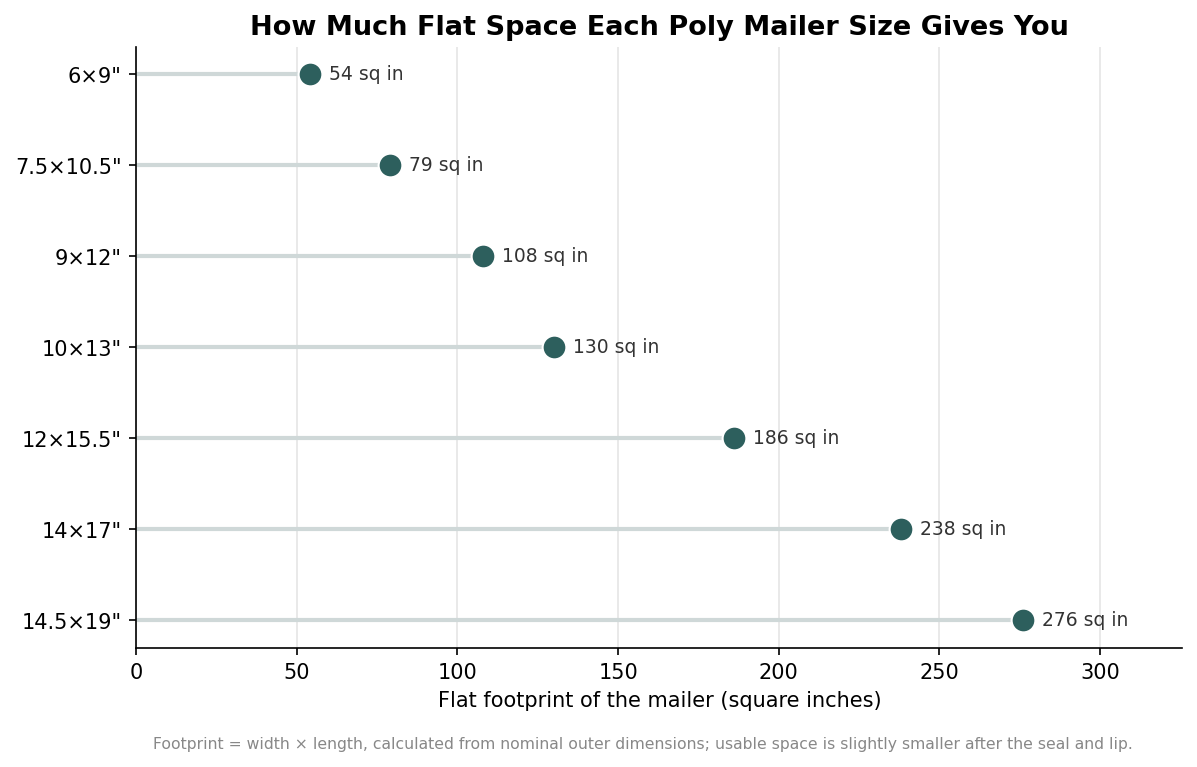
It is tempting to buy one large size and use it for everything, but oversizing costs money on both ends. A garment rattling around in a bag twice its footprint invites creasing and folding damage, and it inflates the parcel’s dimensions right when carriers are measuring them. Under dimensional-weight pricing, a light item in an unnecessarily large mailer can be billed as though it were heavier, quietly raising the per-parcel cost across thousands of shipments. The flat-footprint view below shows how quickly the usable area grows as you step up, which is the same reason an oversized bag wastes both film and postage. The right move is to carry two or three sizes that cover the bulk of your catalog rather than one catch-all.
Multi-item orders, thickness, and custom dimensions
When a single order contains several garments, add the packed thickness of the stack before you apply the formula, because depth is what fails first. Two folded hoodies together can push past the seal capacity of a bag that handles either one alone, so the honest answer for heavier bundles is usually to move up a size and up in film thickness rather than to force the fill. For weight, a 2 mil film suits light documents and accessories, 2.5 mil is the common standard for apparel and soft goods, and 4 to 6 mil is worth the upgrade once contents pass a couple of pounds or include anything with a corner or edge.
Off-the-shelf sizes cover most catalogs, but if your product consistently falls between two standard bags, a custom dimension pays for itself by trimming both film waste and dimensional weight on every parcel. Minimum order quantities and lead times vary by printer and by whether you are adding branding, so it is worth confirming those specifics against real quantities before committing. It also helps to order a small sample run in your two most likely sizes and pack a few real orders by hand before you commit to thousands of units, since the way your specific product folds often settles the question faster than any chart can.
Once you have landed on a size, write it into your packing standard alongside the film thickness and the fold method, so that whoever packs the order reaches for the same bag every time. Consistency at the packing bench is what turns a good size choice into predictable postage and a predictable unboxing experience, and it is what keeps a growing catalog from quietly drifting back toward the one oversized bag that started the problem. The goal is not the cheapest bag or the biggest bag, but the smallest one that clears the headroom formula for the items you ship most.
Leave a Reply